2025: The Year in Sports and Entertainment

We’re at the end of the year. No great movies or T.V. shows remain to be seen. The Sox came as close as they’re going to get to the World Series for the next couple years. The Patriots did remarkably well at football, surprisingly, and the Giants did bad at football, but with the usual dash of hope in the form of an electric running back and quarterback.

Here are some of the things that stood out to me as a consumer of sports:

Boston Celtics: last year was disappointing. The injury of Jayson Tatum put a halt to hopes of repeating as NBA champs, and also dented the team’s odds of a successful postseason this year. I can’t say the team was particularly exciting to watch at their best. Something like the Golden Age of the Spurs. But watching wins is never a bad experience. This season I’m taking a break, and waiting until next season to plug back in. Might have to check out Bruins hockey.

Boston Red Sox: Dealing Devers wasn’t a terrible move, in retrospect, but letting Walker Buehler go was. I don’t think the Red Sox could’ve gotten past the Blue Jays this year. But his intensity and power in the postseason would’ve been useful, as would his presence in the clubhouse. That’s the sort of guy Buehler is on a team. A sparkplug, a firestarter. After he left, Bregman was never quite the same. Buehler pitched well against the Yankees and he might have been able to nudge the Sox into the first round against the Blue Jays (where the Sox, instead of the Yankees, would have gotten thumped out). I’m not sure what that portends for next season. A healthy club could probably make the playoffs again. Will the Sox get far there if they make it in ‘26? I don’t think so, not without a little more hitting and a little more pitching.
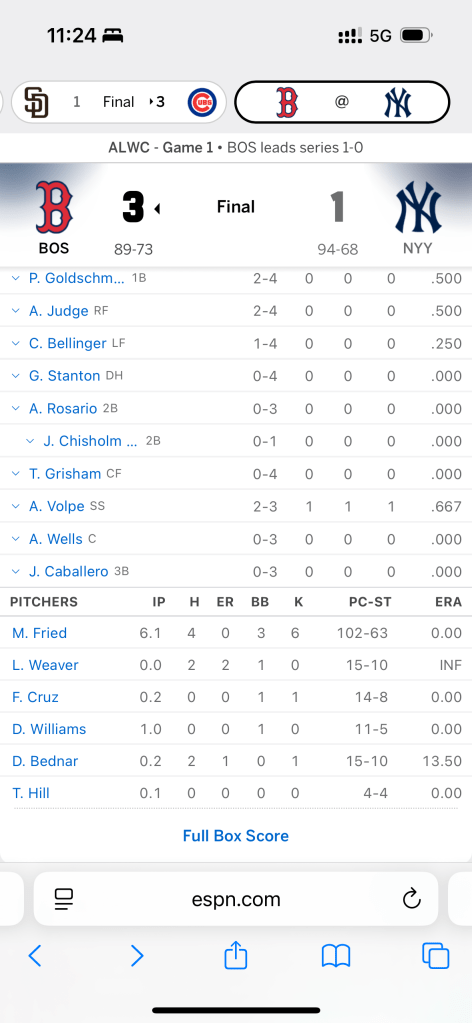
High tide mark for the Boston Red Sox in their 2025 campaign

Having said that, this Sox team was one of the more fun to watch over the past decade. They showed flashes of brilliance, as during a midseason run where they rattled off a couple significant win streaks. They were dismissed with difficulty by a fine Yankees squad — who then got hurried out of the playoffs by a dominant Blue Jays squad — and I’m hopeful the Sox can find a way to build on the pieces they have now. They need everything they had this season, plus one more Crochet-level pitcher (easier said than done) and one more hitter on top of a healthy Anthony and re-signed Bregman (much easier said than done). I’m not optimistic about 2026.

And some of the movies and shows I watched that I either enjoyed, or which I think you can probably skip (in my opinion):

The Terror: An incredibly-cast and beautifully rendered fictional t.v. horror serial that walks the line between natural and supernatural following the crews of HMS Erebus and HMS Terror, two British warships that were kitted out to explore the Arctic and look for a passage through the ice in the mid-19th century — unfortunately for them, during some of the coldest years on record. The historical Erebus and Terror disappeared with all hands lost; in this telling, either a monster or a relic population of cave bears (depending on your capacity to suspend disbelief) were responsible, plaguing and killing the crew once the ships become stuck in pack ice. Had me engrossed from the first to last episode, with very little filler.

Severance: Smarter people have already written about this show; all I’ll add to the discussion is a ringing endorsement to watch this if you subscribe to Apple TV. I don’t remember the last time I cared as much about characters as I did watching this program. It’s an incredible show, a marvelous experience, and you don’t get cheated entering into that world. It’s worthwhile.

Bosch: Legacy Season 3: Friends have heard me talk at length about the original Bosch series, which I really enjoyed. Each episode of Bosch seasons 1-4 (and maybe more) is a joy to watch — one never feels lectured to or manipulated as a viewer — one’s time as an audience member is not taken for granted. That wandered in later seasons, and very much so in Bosch: Legacy, both of the first two seasons of which were not the most enjoyable views. Much of the enjoyment I got watching Legacy was owing to the residual goodwill built up by those excellent initial seasons of Bosch.

Season 3 was a return to Bosch’s earlier form. Each episode was satisfying in its own right, while credibly building that most powerful of Boschian narratives: has Bosch gone too far? Is his moral code antiquated or even beyond gray — has he wandered into irredeemable evil territory? Hint: everyone who has ever bet against Bosch has lost money. Watching the series sell and then rug-pull a compromised or flawed Bosch gets me every time. Really enjoyed this unfortunately ultimate season of Bosch, and Titus Welliver’s exceptional acting (has anyone done a better job of inhabiting a role? As good, certainly. Better, I think not).

Reacher Season 3: The first two seasons were very enjoyable. Very good, bordering on great. This season was a disappointment in so many ways. Whereas in the past Reacher’s feats, while farfetched, felt somehow plausible, this season was filled with absurd and improbable moments that didn’t stretch credulity so much as violate it. If one had in the past been able to suspend disbelief due to good acting and better plotting, this season misfired on both accounts. The characters who were supposed to be sympathetic weren’t. The pacing was off. Even the villains didn’t bite as hard, in spite of an all-out effort to make them. I’d pass on this.

Foundation Season 3: A solid ending to an enjoyable series, particularly if you enjoy Sci Fi and never read the original Asimov trilogy (as I haven’t). Two of the last three episodes — eight and nine — deliver an extraordinary payoff, one of the very best in the series. The final episode, on the other hand, was so wandering and worked so hard to tie everything up neatly that I barely remember it. It’s rare that an ultimate episode is overshadowed by the episode before, but that’s what happened here. This was also one of the few series for which I always watch the opening song — like Mad Men and The Sopranos, it helps set the stage for the episode that’s about to unfold. Recommend!

The Last of Us Season 2: Didn’t enjoy this. I’m told it followed the video game faithfully. I watched the first game played, and not the second — didn’t play either — and watched as much of Season 2 as I did out of loyalty both to the game and to the first season.

Cinema, theater, and literature have always been lightning rods for culture war. Years ago I took some heat for saying I didn’t enjoy the most recent Star Wars trilogy, and imagine I might take some heat for saying I didn’t enjoy this season of The Last of Us. My opposition to Star Wars episodes 7-9 wasn’t opposition so much as I simply didn’t enjoy it; the plot was incoherent, and the decision to complicate Luke Skywalker the way the director did seemed arbitrary and not worth the payoff. I think as a writer or a showrunner if you’re going to bedevil a character, a hero no less, you owe it to that character to give them some form of redemption.

And so it was that the second season of The Last of Us was probably doomed by the video game — spoiler alert, one of the primary protagonists from season one is brutally and bloodily murdered in the first episode of season two. The murder, which does not seem suitable for television (frankly) is ostensibly complicated by the fact that it is seen as an act of vengeance by the daughter of a doctor who is killed at the end of season one, by the same protagonist who gets murdered.

As an allegory about vengeance, I’m sure the seasons both work well. But as storytelling it doesn’t; when I see a beloved albeit complicated hero (he kills the doctor who is about to kill the second protagonist, who becomes the hero of the second season) savagely tortured to death, I don’t think “hmm, life is complex,” I think about the very real brutality meted out today by various invading and occupying countries against minority groups or peoples. I think about the absence of justice, the impossibility of justice.

Movies and books and plays are not spaces to muse on the impossibility of justice — because to claim that justice is impossible is a cynical and self-defeating idea. Art is a fantastical space in which we get to see heroic and upright behavior — perhaps with struggle, with complication, with challenge and difficulty, to be overcome — fantasies in which justice is accessible. Because the world we live in, the real world, is a deeply unjust place.

There are other problems with The Last of Us Season 2. I watched the season to the end. It ends up being a kind of torture. I don’t recommend it, because of its sacrilegious and inhumane treatment of Joel and other characters. Game of Thrones got all the “violence and grit for the sake of violence and grit” out of my system. Just can’t watch stuff like that any more.

Of literature I read little, and journalism I read quite a bit. The only literature I read this year were stories and books I’d missed by Philip K. Dick (Do Androids Dream of Electric Sheep), by Stanislaw Lem (Imaginary Magnitude), and some rereading of Hemingway and Carver; the remainder of my reading was tied up with Albion’s Seed and various legal documents relating to Connecticut’s Constitution and General Statutes, so as to become smarter about the state I live in. I tied up my service to Branford’s RTM, as I wrote in another post, and having helped contribute to the law of my town with several ordinances, I was interested in learning a bit more about the context in which those laws were created. It’s interesting. It does feel at times that the code of a state or a country ought to be simple enough that a citizen should be able to understand it before graduating high school; my feeling, reading Connecticut’s state laws, is that they require a lawyer to navigate. While the process by which we have arrived at our laws, statutes, rules, and ordinances as a state has certainly been democratic, what exists today is not egalitarian, and probably a violation of the principles on which the state (and nation) were founded.

For journalism, I read The Wall Street Journal every day. On the day (December 18) I was to choose between continuing my subscription or not, I elected not to; $50 a week for what feels increasingly like banal stories about American culture — the sort of thing I remember reading in The New York Times when I was in high school — was too rich for my blood. This year I’ll likely pick up a subscription to Bloomberg or to Financial Times, I haven’t decided which.

My favorite new game: Is the story from 2025 WSJ or 1995 New York Times?

Final recommendation for 2026: avoid this snack at all costs unless you have superhuman powers of self control.
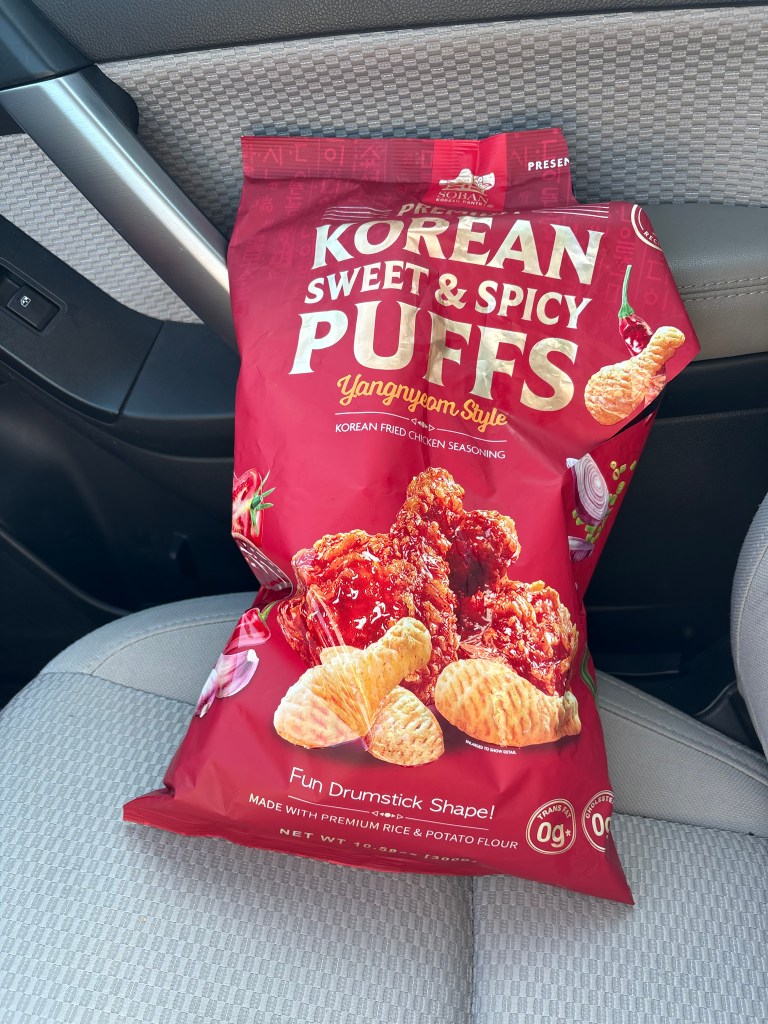
Danger! Addictive! It’s sweet and it’s spicy, at once!

A Short Indirect Personal Remembrance of Frank Gehry, Tied to my Grandfather

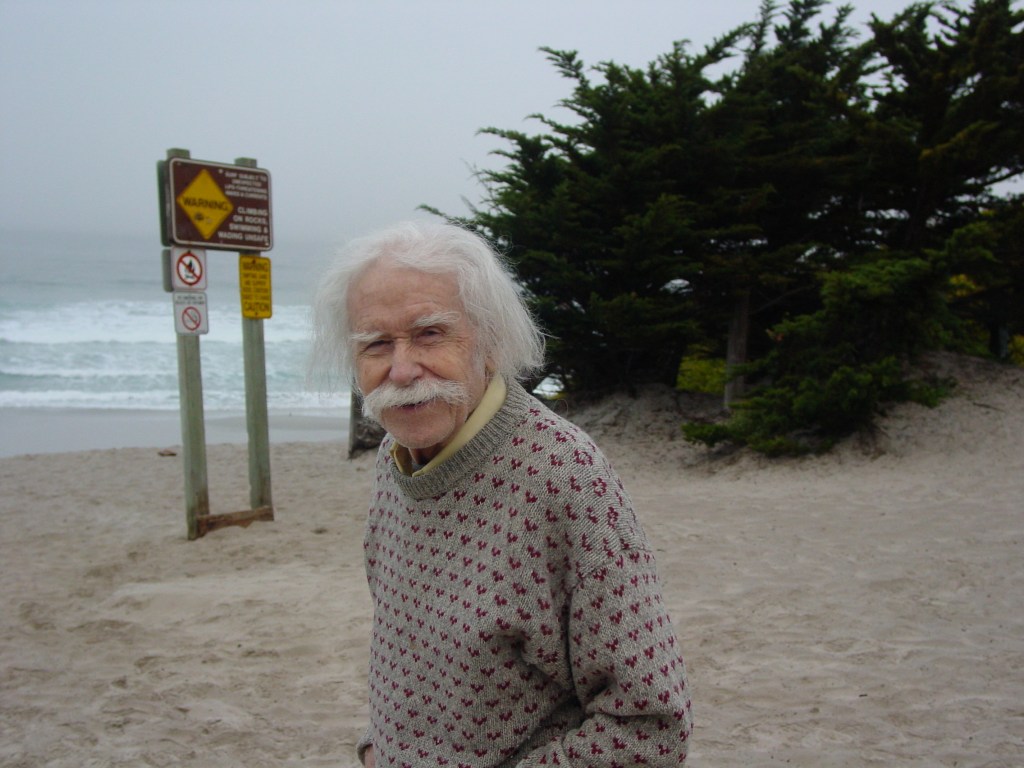
One of my favorite memories of my father’s father — my grandfather, Wes Bonenberger — was the trips we’d take together to different cities; Los Angeles, New York, Boston, San Francisco. His favorite was San Francisco. He loved the look of the city, the way the buildings lay on the land and hugged the rolling hills. He’d talk with me about architects he admired — Frank Lloyd Wright, for whom he’d worked as a draftsman early in his career (only job he’d ever been fired from, he’d say), and Frank Gehry, with whom he’d attended architecture school and hung out at USC in the 1950s.

Wes Bonenberger in Carmel, where he lived for much of his elderly years before returning to Connecticut.

My grandfather didn’t find it difficult to meet people, but he didn’t have many close friends. He was very picky about the people he opened up with. I could say this was a legacy of the McCarthy trials, when people in his social circle were smeared as communists and lost their careers, but I think it was always part of his character. People saw him as quirky. He had a deeply cynical sense of humor, and was thoroughly anti-authoritarian, but at his heart was an idealist who loved the little guy. He was the little guy! A lower middle class kid with a knack for designing and fixing things, who after getting out of the Army following WWII went to USC on the GI Bill.

When we’d walk through cities, Wes would talk about architecture, try (and usually fail) to impart some wisdom to me, and often end up discussing contemporaries. Gehry’s was a name that often came up — one of his close friends at architecture school — a fellow iconoclast, someone who found the architectural mainstream in 1950s America not just stale, but horrifying.

For this reason I’ve always looked at Gehry’s projects with interest; not as someone with deep aesthetic appreciation for his work or what went into it, but for the larger project of disruption and complication, of which he was an enthusiastic and deliberate part.

Farewell to the last contemporary living connection to my grandfather I’m aware of — farewell to Frank Gehry.

Running on Empty

Running has been a big part of my life since I was a kid. At first it was biking — using my dirt bike to get to my friends houses, or going up and down the gravel roads of the idiosyncratic and progress-resistant community I lived in as a child, Killam’s Point in Branford, Connecticut. That too was a form of running — building my leg muscles, letting me slowly and progressively push my endurance levels, getting me comfortable with wiping out on the side of a road that rarely saw traffic.

Later, I joined my prep school’s cross country team. Here is why I chose cross country over soccer, or football: I was feeling extremely stressed, academically and socially, and wanted something that wouldn’t be particularly stressful. During recruitment, members of the cross country team ran out in morning assembly wearing shorts, sweatbands, and thigh-high socks, eating from a bag of Doritos and tossing a frisbee back and forth. It was chill. Not cool, not impressive, just low-intensity, do what you feel like. I signed up on the spot.

This clever bit of propaganda was a massive lie. I worked harder and pushed myself further physically running cross country than I would until I reached Ranger School in the military, or, later, combat in Afghanistan. It turned out that I had a competitive streak. Running cross country helped bring that out and focus it, turn it inward, so much of the time I was competing with myself. We ended up fielding a pretty good team my sophomore year, and then, my junior year. Sometimes I wonder what would have happened if I’d stuck with it senior year.

In the military, I reached my peak as a runner. I ran the Florence Marathon in 2006, and regularly logged around 30 miles per week. These aren’t elite numbers, not even particularly impressive for amateurs. But I was benching around 240-250lbs, averaging 6 minutes and 45 seconds for 5 mile runs, and 8 minutes and 30 seconds for runs between 9 and 10 miles long.

Most importantly, I felt great. Running had by that time finally delivered on its promise to make me feel good — chilled out, relaxed. By the time I left the military, running with music was a solid way for me to destress and decompress. It wasn’t about staying in shape, it was about staying sane.

So when I read this piece in today’s Wall Street Journal about running, something about my journey clicked into place. Earlier this year, I made the decision to shed wearables and music entirely when I run, just to get out and enjoy the process as far as my body will take me.

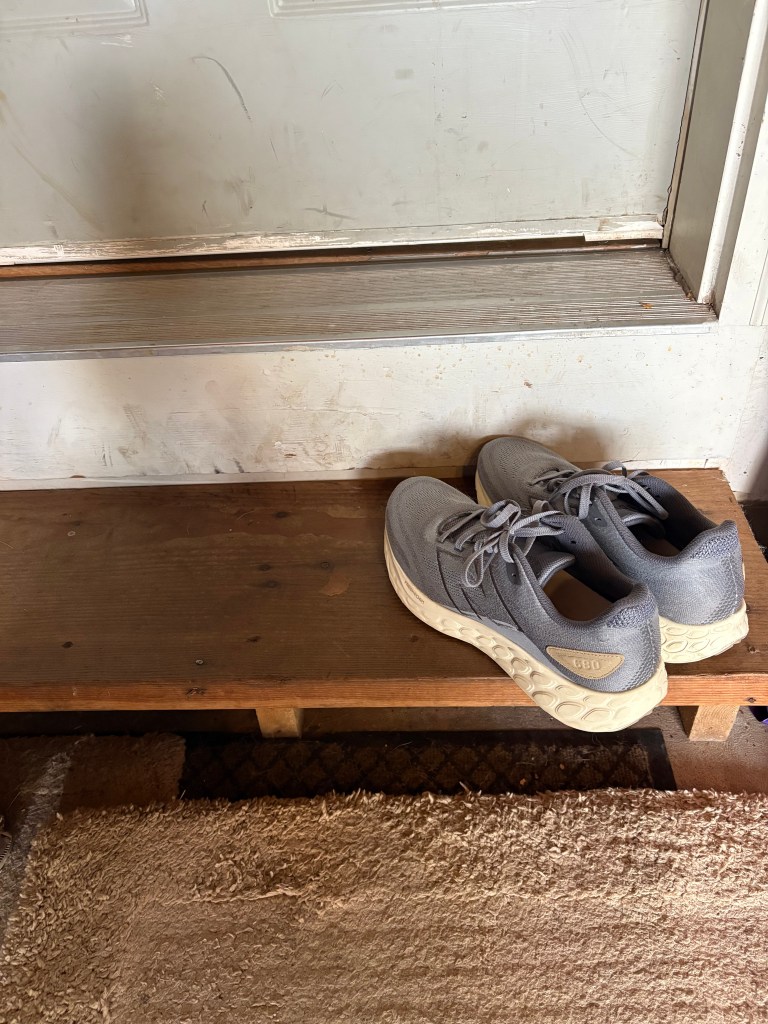
Throw on the old running shoes and go for a spin, let the mind drift where it will

My right knee is pretty banged up, which limits me to certain trails, and certain distances. I can still do a jog pace — but anything longer, or on roads, will lead to the knee (which I injured during my first deployment, and through which I gutted) giving me major trouble in the days after. So practically speaking I’m never on my legs for longer than a half hour anyway.

But it’s so nice to do that half hour or twenty minutes without feeling compelled to measure — distance, time, songs listened to, heartrate achieved — none of it. It’s so nice to just get out there and do what my body’s still capable of at the tender age of 48. That, folks, is a benefit of getting older — and a little bit wiser.

Freezing Senior Citizens’ Property Taxes in Branford

During the election for first selectman, Josh Brooks made an interesting pledge. “I am proposing to freeze property taxes for qualified Branford seniors,” he wrote on his campaign website, and shared on social media.

Is such a plan feasible? Yes — other towns have already implemented some version of it. In fact, Branford has an interesting mechanism in place already that protects senior citizens: seniors can elect not to pay their property tax while alive. After they pass, the property taxes that are owed as the result of nonpayment are collected from the estate, essentially functioning as a type of lien. But the intent of Brooks’ promise is clear: elderly Branford residents don’t need to worry about property taxes leading to losing their homes. That’s a big deal.

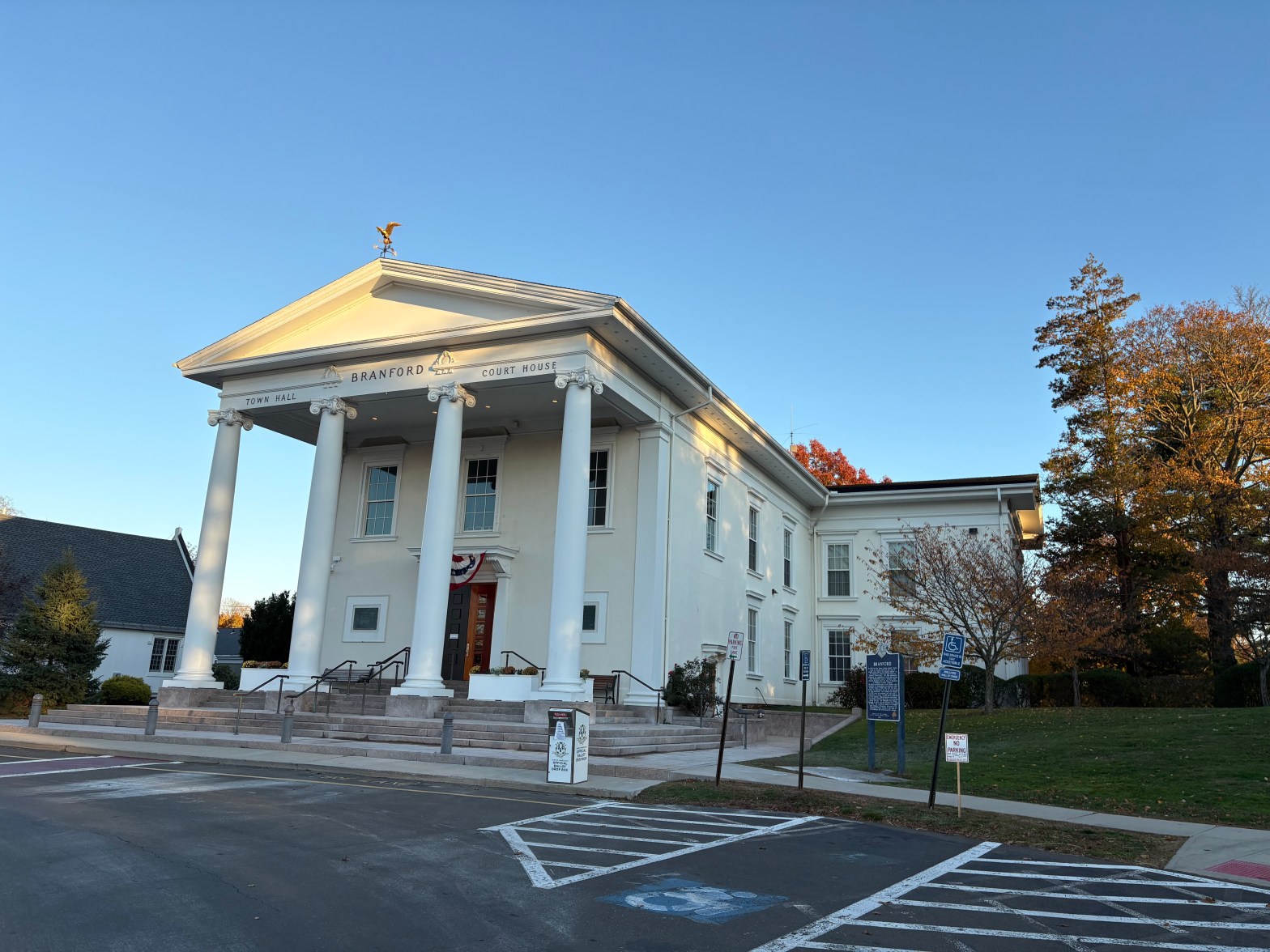
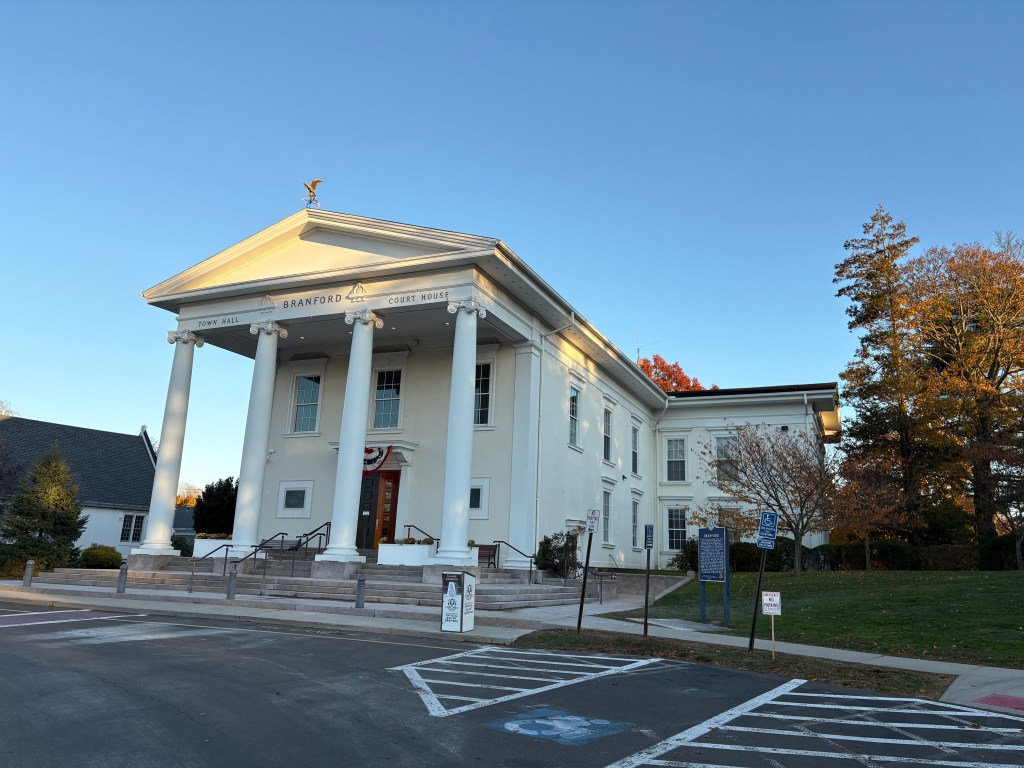
Photography is my passion: a poorly centered photo of Branford’s Town Hall

The senior tax freeze could take the existing policy to another level. The idea, as I understand it, is to cap a property tax rate for eligible senior citizens so that while taxes on Seniors’ property could go down, they wouldn’t ever increase as the result of market fluctuations.

For folks on a fixed income who watched in horror as their property taxes shot up in 2024 by 20% or more despite not having made any improvements to their homes, that’s a big deal. Many homeowners were stunned — normally, the reval doesn’t result in anything near that rate. People moving to Connecticut in the wake of COVID plus other variables contributed to that spike in home values. In other words, forces beyond any individual’s control conspired to make it harder to sell and buy housing in Connecticut.

Some residents were unbothered. If you were flexible about employment, and of an age when moving to another state wasn’t a big deal, you might have bought a house for $350k in 2015, then sold it for $600k in 2022 and moved to Kansas or Minnesota and been able to buy the same amount of house outright in a different place with the profit. That’s one of the advantages of living in the United States — the border between states is often more of an opportunity than an impediment to progress. At least, if you’re mobile, and at a point in your career where such mobility makes sense.

But for elderly residents, there weren’t many good options. Particularly for those folks who had a sentimental attachment to their home — it was in their family for a long time, or their grandparents built it, or it was their forever dream house — even though the money was right to sell in 2023 or 2024, those same pressures sending the price of your home up meant there were few (if any) good options to buy. For folks who were living in Connecticut, the spike in housing prices was across the board, so selling for a higher price also meant buying at a premium if you had to stay local, minimizing or even nullifying the advantage of a move.

Branford’s current policy is nice, and decent, and certainly in the correct spirit when it comes to taking care of its oldest citizens. But Brooks’ proposal offers an interesting expansion on the idea. What if, rather than simply accommodating seniors (a nice thing to do) by promising not to kick them out of their homes, the town offered a financial benefit — certainty on their property taxes — essentially, a bonus for their spending a significant portion of the productive part of their lives paying property taxes in the town, and contributing to its prosperity?

I liked the idea when I first heard about it, and I like it now. It offers seniors a kind of dignity that the current arrangement lacks. Rather than saying “we’re not taking your money now, we’ll take it after you die” like the ghoulish children of some Victorian aristocrat in a Dickens novel, Brooks’ new proposal seems to be angling at something more like “Over the past few decades, you built the town we live in today — now let us do something for you.”

And it won’t — in whatever shape it takes — do away with the requirement to pay property taxes. Folks will still pay tax! It will just cap it at a reasonable place. Maybe the age ends up being 70, or 75. Maybe the residency requirement ends up being 30 years. So you know, with the Branford ordinance, that when you move to the town and buy a house in your 30s or 40s to raise a family, that when you’re older that you will never pay a higher property tax rate than whatever the number is when you turn 70 (or 75). And of course, if property taxes go down, yours will as well.

That’s certainty, that’s stability — that’s peace of mind. That’s a compact between the town and not only its oldest and most committed long-term residents, it’s also a compact between the younger residents and the older generation. The elderly have always been held in high esteem in New England; this represents a welcome return to that tradition.

What about the downside? The town will receive less revenue. At a moment when commercial activity has withered in Branford, and the fewer companies who have stuck around in the town are paying less tax, more and more burden is falling on residents to make up the difference. This is something to consider, and folks ought to examine the question at length before committing to any particular plan. As far as I understand it, finance is like farming in one regard: certainty is the most important component. Even if rain only comes once a year, if you know that, you can find ways to offset the dry periods, and find crops that grow under such conditions. Similarly, if the Board of Finance knows upfront that there are limitations on the taxes they’ll raise, they can come up with plans and schemas to account for those limits. Maybe certain projects will be built more slowly, or on a longer timeline.

The details remain to be worked out. But I’m looking forward to Branford’s RTM picking up the issue and giving it the thorough consideration that this project deserves. It’s the sort of thing that will bring the right type of citizen to Branford, and not for a little while — for the long haul. I hope it comes into being.

Leaving the Branford RTM

This started out as a post for social media. Once I started writing, I quickly realized I had more thoughts that I wanted to share than made sense for a post. No surprises there!

I am not running for reelection on Branford’s RTM this year. After two two-year terms, I feel that I’ve done a decent amount of service to the town, and fulfilled my responsibilities as a citizen and civic-minded individual. It’s been a great experience, and between chairing the Public Services committee and serving as clerk for Rules and Ordinances, I’ve learned a lot about how a Connecticut town functions and why. Here are some of the thoughts, conclusions, and observations I’ve made during that time.

First: very few people know much about local politics, even though it’s the level over which one has the most control. A middle-class Connecticut resident probably pays 30-40% of their total tax bill in property taxes, which are what fund local government and services. Rates of participation for most initiatives are vanishingly small. As a result, individuals and small groups have an incredible ability to impact legislation and votes. Case in point: the RTM voted to approve $7 million for artificial turf fields because a half dozen parents showed up at a meeting. The town hastily voted to sped $7 million on fields that are practically guaranteed to injure more kids who play on them! And if you don’t like science, ask someone who stakes their livelihood on rigorously maintaining good health. I was leaning against supporting the measure, but the passion of the parents changed my mind. A small minority wanted these fields very much. I mention this not to express regret at my vote, but to share how a group of vocal minority showing up absolutely impacted a consequential vote.

Second: Local politicians tend not to have training or experience. Branford’s RTM is comprised of unpaid volunteers, with two exceptions: the RTM’s moderator, which is paid a very modest stipend, and the RTM’s clerk, which is paid an even more modest stipend; hundreds of dollars per year. Very reasonable for part-time work which is demanding and important.

To get 28 people in a town of 28,000 to show up monthly and do hours of work each week besides on committees and in one’s own district for no money testifies to the importance of democratic representation in New England. In one form or another it has been our way for nearly four centuries. Far more, if one believes that our ways were imported and adapted from English and Scandinavian forms of government as is the argument advanced by David Hackett Fischer in Albion’s Seed. Isn’t that remarkable!

There are always pressures brought to bear against volunteerism, by people who want or need to be paid for their time, and by people who feel that paying for labor results in higher quality labor. Having sat inside the RTM for four years, at this point, I feel strongly that our ways ought to be preserved as is; there is no argument for professionalizing government beyond an absolute minimum that outweighs to me the arguments against it.

Branford circa 1868. This is how I learned Short Beach used to be on the Farm River.

Third: Ordinances. Rules and laws passed by the town to enforce proper behavior. All the time, I see on Facebook folks posting about the importance of their rights and liberties, and how tyrannical it is that they be taxed to do a thing they want to do. If Vermont puts a $25 tax on campers to stay overnight at a state park (I don’t know if they do), that’s tyranny. If New York City requires $750 for a pistol permit (I don’t know if they do, I’m making that number up), that’s a tyrannical tax.

But the way a town sees this sort of tax or fee isn’t as a revenue-generation mechanism. The way the people drafting the ordinances isn’t to raise money, either. The reason the fees are so low is that the purpose of ordinances and laws are to encourage those thoughtless or disrespectful people whose actions disrupt their town or neighborhood’s peace and harmony to respect it, and, if that encouragement fails, to offer the town and neighborhood a mechanism for correcting thoughtless or disrespectful behavior.

When framed as a question of rights, anyone who isn’t familiar with the important specific context of the ordinance will probably think selfishly about how important their rights are. Rights are important! Tyranny is bad! That same person, when living next door to a person who has an improperly zoned mechanic shop in their back yard and loudly revs car engines at 10pm on a work night may abruptly become interested in constraining their neighbor’s rights slightly, in exchange for quality sleep. One doesn’t buy a home in a residential neighborhood thinking you’ll be living next to a body shop, and when your neighbor turns out to be that one-in-a-hundred sociopaths who simply does not care about others, or about obeying the rules — because of his “rights” and “liberty” — you’ll be grateful ordinances exist.

Fourth: The limits of law enforcement. Ordinances on the books are one thing. Getting overworked police departments to enforce ordinances is another. Particularly in small towns, noise is a constant issue. In Branford, there is a tension between expensive riverfront condominiums enjoyed by retirees, and the Stony Creek Brewery, an establishment that breaks even (barely) by holding noisy concerts and events late into the night. The Branford PD is often at capacity and unable to respond to reports like these. [note: the SCB has since been bought by the New England Brewing Company (NEBCO) and hopes are high among citizens that this will mean a change in how that space is used, though I remain skeptical]

This gets back to the tension between volunteerism and professionalism I mentioned in my second point. For hundreds of years, Branford (like most New England towns) relied for its law enforcement on volunteer constables who were elected. By the 1920s a variety of factors meant that policing by constables was no longer suitable, and Branford (also like most New England towns) employed a full time police department made up of professional officers. Since then it has become decreasingly possible to mobilize citizens for law enforcement or law enforcement adjacent work; state-level ordinances, rules, and credentialing make policing a very difficult field to move into with volunteers.

This trend can also be seen in America’s approach to a full time professional military (active duty went to this model after Vietnam) and the ongoing transition from volunteer to full-time fire departments. Systems that started out as made up of citizens volunteering their time for important roles morph, over time, into systems dependent on full-time professional employees. 

The problem that one runs into on a local level is: you can only afford so much. Taxes in Connecticut are notoriously high, in part because — well — New England has been part of the U.S. longer than most other regions, and it has always taxed citizens at higher rates, for more services. That’s what you sign up for when you settle and make a life in New England. High taxes, robust services. To hire more police to handle more ordinance violations, you’d need to hire more officers. And the appetite to raise taxes higher (each officer comes with a lifetime training, salary, retirement and benefits obligation to taxpayer of millions of dollars) is nonexistent.

Financially, I believe our town (and maybe our state!) are near the limits of what we can afford through progressive taxation. Particularly given falling rebates from a federal government that is overtly hostile to the New England way of life, I believe that it is time to *de-professionalize* and to emphasize volunteer roles for certain ordinance enforcement. A local constabulary could easily accomplish this role. In fact, that’s precisely what it did for the 230 or so years before Branford (and towns like it) opted for a full-time police department. One doesn’t hear about civilization collapsing into lawlessness in Connecticut between 1789 and 1920 without a professional police force because that never happened.

I think we collectively need to have a conversation about ways to spend less money for more services, and that means mobilizing volunteer networks. Professionalization is almost always the best way to provide services to a town, but it’s also the most expensive. At a certain point we’ll run into that reality.

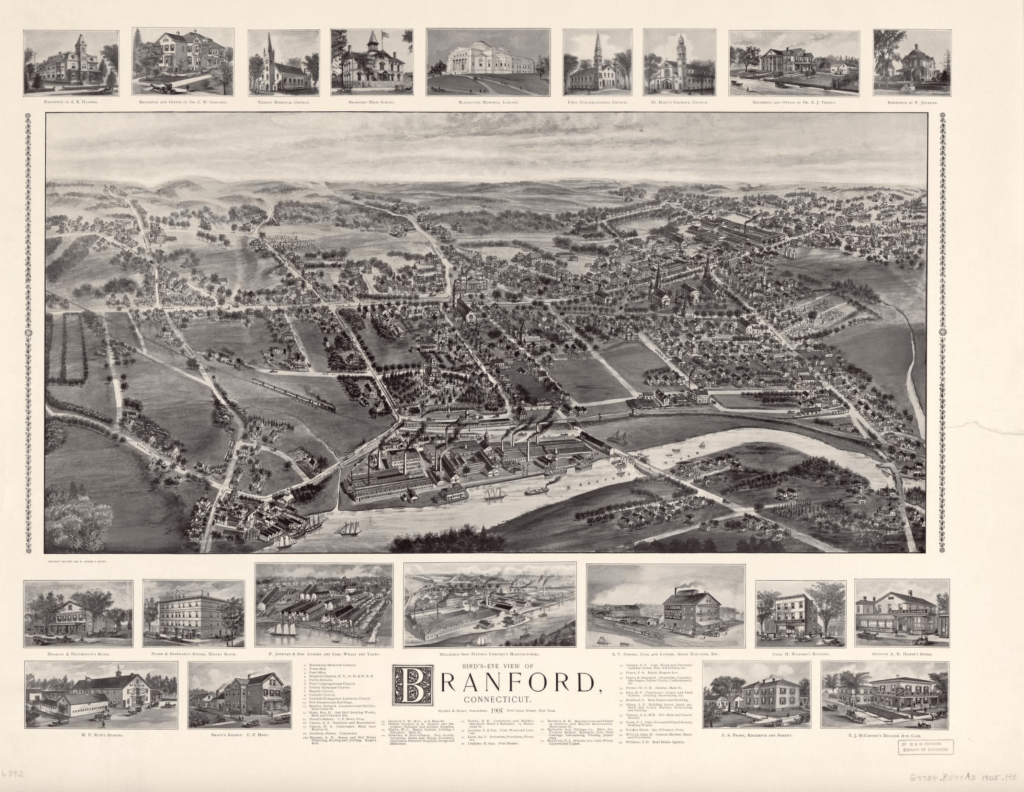
Branford by 1905. The trend in Branford, like many towns, has been toward increasing professionalism and institutionalization, to the detriment of civic engagement and democratic action.

Fifth: Partisanship. In voting terms, you see that play out with straight-party votes. Behind closed doors, though, in caucus, there’s a lot of nuance.

The decision to pass the budget with RTM interference in the administration and Board of Finance’s recommendations — essentially using the RTM’s power to force BoF and the Selectmen to spend more out of the undesignated fund — was the product of a lot of wrangling. On the Democratic side, some wanted the town to spend more from its undesignated fund. Everyone was onboard with the town offsetting tax increases — the question was how much, not whether to do it or not. I wrote about the process here.

Partisanship, though, is when you see people fabricate arguments to support their position, rather than using their position to develop arguments. Modern politics is driven as much by partisanship as anything else. And one of the things I’ve learned inside the process is that partisanship develops its own logic. It is what The Great founder George Washington meant when he warned against factionalism. There are people on the Republican side who cannot ever accommodate Democrats, and people on the Democratic side who cannot ever accommodate Republicans. Friends, if you never see any merit to what the other side is saying, if you find yourself constantly arguing one side of a dispute, you’ve become a partisan. The problem is you!

Conclusion: there’s incredible power and potential at the local level. Knowing how the town government runs as an abstraction and being inside it are two extremely different things. This, local government, is where our ancestors put the bulk of their efforts — not the state or federal government — and there was a reason for that investment. They believed in the spiritual and moral utility of a certain kind of work, the Puritans who put this all together (at least, in the Connecticut and New Haven colonies, which eventually became our state, and those of other New England colonies). Whether you tend to agree with them or disagree, I’ve come to see great wisdom in the way they organized their social and political lives to work alongside their professional lives. They hoped that in organizing their private lives a certain way, they would create virtuous and harmonious organization of their public lives — and that organization would move upward in a useful and natural way, such that governors and (ultimately) presidents would be of that modest, thrifty, and unostentatiously prosperous fiber.

It worked! The Ivy League consists of some the best colleges in the world! It still educates the lawyers and judiciary and professional politicians that have kept our country humming along for centuries! That we have in recent decades turned our backs on the wise and moderate teachings of our ancestors does not in any way diminish their success.

Misreadings, misunderstandings (both deliberate and ignorant) and misuse have all conspired to bastardize what it means to be a New Englander. It’s not difficult to see what I mean by that on Instagram and TikTok if you’re still on either platform (I am not). This is not, as far as I can tell, a recent phenomenon; it’s decades old. As big cities and the American West have lost their allure for hucksters and get-rich-quick schemers, more and more people have brought this distinctly unpuritanical (if not outright unAmerican) idea of hedonistic prosperity for its own sake — the accumulation of wealth as a good unto itself, rather than as a means to an end. This has been to the detriment of Connecticut and Branford, and New England states and towns everywhere.

Here is my feeling: at some point our culture — local, regional — will have to fight back against the corrupting and decadent influence of excess; it will have to reclaim as our birthright a boring, hardworking, and spartan way of life and way of living for which the people who built this state became famous. It is possible to do that in one’s home. To a limited extent it’s possible to put energy and effort into accomplishing that at the town level. Much depends on that project. I hope we’ll figure it out before it’s too late.

Preparing for an Emergency or Disaster (Mobile)

Recently, several acquaintances have asked me how to prepare a “go bag” and it got me thinking. There are many resources out there that offer solid recommendations on what to buy for a disaster and why. Some are disaster-specific (how to prepare for an earthquake versus fires versus a hurricane); others are nonspecific, but focus more on the specific gear rather than a particular situation.

My employer, the American Red Cross, has one of the best overall suite of products for getting yourself and your family ready for some type of natural disaster, and the types of challenges a person can expect to encounter.  The U.S. has tools online — for now anyway! — under FEMA, while that agency still has funding. Both of these are useful and make for an interesting if suitably alarming Saturday read.

Meanwhile I thought I’d offer my thoughts about disaster preparedness briefly. Like most people my age (47 as of writing) I’ve had some experience with natural disasters as an adult. I’ve lived through several blizzards, three hurricanes (Gloria, Irene, Sandy), and one high wind event (tornado briefly touched down in my town). I’ve also had experience with war, having helped evacuate my wife’s parents from Kyiv in March of 2022, while Russia was invading, and deployed twice to combat in Afghanistan as an infantry officer.

A brief aside on war: while government resources and the American Red Cross focus on natural disasters and infrastructure disasters such as chemical spills or radiation incidents, nobody talks at length or in detail about the possibility of war in the U.S., or the steps one would need to take to avoid that man-made disaster — a glaring blind spot, though understandable. What government wants its citizens to think war could happen within its borders?

Rather than break disasters into artificial categories such as “natural” and “man-made,” I think a better way to think of disaster prep is “mobile” and “static.” There are some disasters that are fast moving and unpredictable, where one will need to move quickly from one’s home to some predetermined safe area if possible (and in any direction away from the disaster, if not possible). Other disasters are such that sheltering in place and waiting for services such as electricity to be turned on again is the best course of action. In both cases, one will want to approach one’s preparedness for the disaster with a maximum of caution and care.

Here’s a simple way to prepare for disasters of any type using this binary framework.

“Mobile” Disaster Preparedness

I’m beginning with mobile preparedness because one can carry less on one’s person or in a car. For that reason, the kit you build in order to prepare to move in response to or to avoid a disaster must include essential things only; heavily focused on survival for as long as it’s necessary (practically speaking, 5-7 days). Such a kit has to fit in a backpack if you plan to be on foot, or in the back of a car if you have a family and plan to be driving.

It’s also convenient to begin with “mobile” disaster preparedness because you can take everything you put in your “mobile” kit and use it for any other kit you compile.

One can even imagine tiers of mobility, though this is already getting into the weeds (and with disaster preparedness, you really don’t want to get into the weeds — the weeds being survivalism, which is a whole other kettle of tea). There is the mobility which is a few things you can put in your pocket or carry while running. There is the mobility that is a few more things you keep in a backpack and practice using (always practice once a year). Finally, there is the mobility that is stored in the back of your car for your family, requiring no more than two people to lift. Like a nesting doll, the equipment one uses for the first should be part of the second, and the equipment for the second (the backpack) should be part of the third (the car).

Tier One: Mobile Disaster Response With The Clothes On Your Back

This is the most basic disaster response, and any of our ancestors would have understood it. You have to move quickly and for whatever reason using a car isn’t possible or feasible (path you’d take by car is blocked or you don’t have a car, no time to find the keys, etc.); maybe speed is essential and a backpack with 40lbs of equipment will slow you down too much. In this case you want the following:

-Water purifier or water purification tablets + minimum 16oz or 20oz water bottle

-multitool

-all-weather matches

-rainproof poncho

-plastic baggies

-knowledge of basic fieldcraft

-wallet w/identification; preferably with credit cards and $100 cash, but most importantly with a driver’s license or some other form of valid state-issued identification

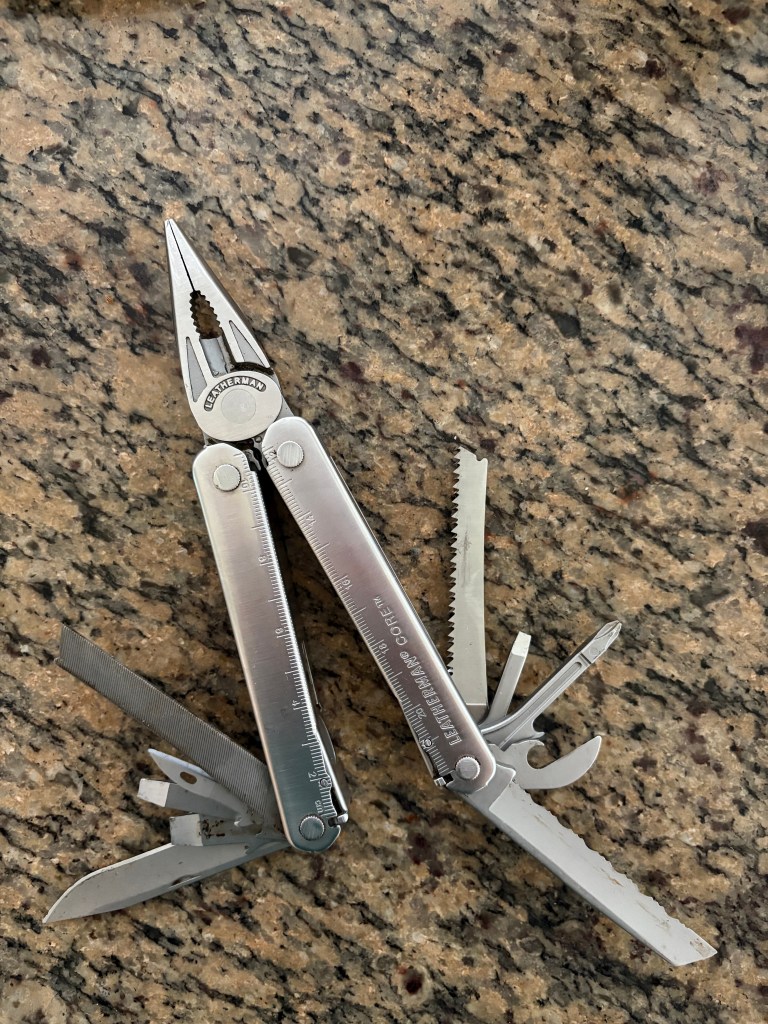
The multitool is an essential piece of any disaster preparedness plan; I’ve been carrying the same Leatherman since 2006, and have used it countless times since for a multitude of tasks.

Store the essentials of this kit by the front door or back door of your house or apartment, in or next to your poncho. This covers your immediate bases for survival: drinking water being the most urgent. If you know you have access to potable water, you have just bought yourself ~3-4 days of extremely rough living, which is, in almost any situation, enough time to find help for whatever disaster is, presumably, affecting everyone in your area. For clean drinking water you need (1) a water purifier or purification tablets, (2) a way to store the water [the water bottle] and (3) access to any water source. Good water purifiers can clean even the most rancid water source, though it is no way to live for long periods of time. In this case, you are focused on surviving the initial disaster and displacement.

Your multitool — I have an old Leatherman I got before my first deployment to Afghanistan in 2006 and use for household chores — should have a knife, pliers, various screwdrivers, a saw, and some means by which to open metal cans. It can be used to help fashion a crude shelter, start a fire, or do the various little chores one will need to survive outside for a few days.

All weather matches will help you start fires; together with the multitool and some basic fieldcraft, it will be possible to start a fire even in the rain.

A poncho might seem like an odd thing to have hanging up in one’s closet, depending on your cultural background and location; it is an extremely useful piece of kit for surviving under the most austere conditions. Together with your multitool and a few sticks, that poncho can be turned into a waterproof lean-to if it’s wet outside, and a halfway decent improvised sleeping bag if not.

Plastic baggies are to keep things dry — especially your wallet and the matches.

Knowledge of basic fieldcraft, such as how to start a fire, is important for mobile disaster preparedness. Fire will keep you warm, and can sterilize food and (provided you have a suitable container) water. Understanding and practicing building a fire from very little material (dried twigs and small branches and moss) is probably the one essential skill; everything else is a potential nice-to-have.

Finally, a wallet with identification is for when you get to some place that can help you; a safe town the disaster has not reached, a group of people or an organization that’s capable of helping you. A disaster isn’t the end of civilization, it’s just a (one hopes) temporary adjustment in civilization’s borders; a space of temporary lawlessness and disorganization. Your priority is to get back to civilization as quickly as possible and by any means necessary. That $100 will help you do that if the credit cards don’t work, but isn’t so much money that it puts a target on your back.

Tier Two: Mobile Disaster Response With a Backpack

In tier two, one has both the time, presence of mind, and opportunity — and the situation is suitable — to grab a backpack of no more than about 60 pounds; heavy, but not unmanageable for short movements. Such situations could include (1) you don’t have a car but a buddy does and you’re headed somewhere to survive for a week or two, and (2) you’re being evacuated from a place for longer than a week; it’s not clear when you’re going to be able to return though the assumption is that you can return at some point in the future.

Using the principle of “building out capability” I mentioned earlier, everything from the Tier One package goes into the Tier Two package. Thus, you have the first couple pounds of stuff you’ll need to carry.

Things for your backpack that will make some approximation of modern life feasible:

-sleeping bag rated for 32 degrees Fahrenheit. Sleeping bags deteriorate over time, so understand that even a very high quality bag carried by your father since his time in the Guard during Vietnam may not offer the protection it once did.

-If you opted for tablets in the tier one kit over the purifier before, tier two is the time to pull the trigger on a good quality purifier. REI carries a great selection. In general you’ll want something ceramic, capable of purifying spring, stream, or well water. $50-100 will give you peace of mind that nothing bad is making its way into your digestive system. Tablets are ok for a couple days, but you won’t want to be using them for a week. 

-frying pan and boiling pot. Boiling water for food, coffee, and drinking will be important (the pot), as will the ability to cook masses of food at once (the pan).

-a mug. If you have to spend a week in the wilderness or something approximating the wilderness you will quickly learn that one of the great challenges facing human civilization is carrying and storing potable drinking water. Creating it is a huge hassle.

-a hatchet. For a week, you will need the ability to create more wood than it is practical to gather by hand, and even then, you’ll be surprised at how long it takes to generate the fuel you need for things like cooking.

-a small hand/hack saw.

-a good steel camp spork.

-two changes of season-appropriate clothes in addition to the clothes you are wearing, stored in a high quality garbage bag or some similar waterproof sack. If planning for a week, you will want to build in a couple days for each article of clothing you have to dry if necessary. The weight of a shirt, pants, underwear (optional) and socks can go from a pound or two for summer wear to a few pounds for winter wear. This shouldn’t take up more than 10 pounds in your bag. Long sleeve shirt and long pants only. Underwear should be moisture wicking / easy dry, whether it’s short or long.

-an extra set of hiking boots or sturdy shoes.

-cash; $500 for emergency use.

-all important documents in a ziplock bag (copy of ssn, birth certificate; passport; driver’s license)

-depending on where you are and plan to be going, a pistol with a couple clips of ammunition

-Two packages (100 count) of wet wipes. This will be sufficient to keep you clean and sanitary for a week. No more needs to be said on that front.

-hygiene kit. For brushing one’s teeth and keeping clean; foot powder if you expect to be walking a lot. Shaving probably not necessary.

-easy-prep food. 21 pounds of this depending on what else you pack. The average person can get by with about 3 pounds of food per day. Unless you’re an experienced woodsman and can augment that food with fish or game, you just need to steel yourself for an uncomfortable week of eating less than you’re used to. If you’re going to a pre-planned location such as a hunting cabin or second home, it’s possible that there will be extra food already stockpiled; this is something you’ll want to figure out beforehand. In any case, bring the minimum of what you’ll need to eat to get by. An emergency is a bad time to discover that someone else forgot to restock a larder.

-external battery, charged. Can give your smartphone an extra couple days of life if you’re using it heavily; if used judiciously, is perfectly sufficient for a week.

-smartphone

-camp stove. I have a MSR Firefly I use when camping that has stood me in good stead. It means keeping a 16oz portable tank or two with propane — but if you’re using it once a year and then cleaning the stove afterwards, you’ll keep it functional and clean, and understand how to use it. This is far more practical than open-fire cooking. Again if you’re heading to a cabin you might end up having access to a stove and more food than you need, or an older fireplace with one of those grill mechanisms (my parents have one of these and use it when the power goes out due to storms or hurricanes, they’re not bad). If you do you may never use the camp stove. Like many of the things in tier two, it obeys the principle of “better to have and not need, than need and not have.”

-two gallons of potable water. That’s 16 pounds. It will give you sufficient water to not die for two days, plus cook some food.

-a set of 5  bungee cords; 4 medium length (2-4 feet) and 1 longer (4 feet+).

-100 feet of 550 or paratrooper cord.

-First aid kit.

Two other considerations are preconditions for this loadout to work with maximum effectiveness. The first is a plan, and the second is, I cannot stress this enough, intermediate fieldcraft. Nobody wants to hear that you have to think through some of this stuff to begin with, but if you’ve thought through the possibility of climate or human disaster to the point where you’ve invested, now, $1500 or so in a durable bugout kit that will give you a week worth of survival outside the comforts of civilization, you really owe yourself the time it takes to ensure that investment isn’t squandered.

The fieldcraft first. That doesn’t just mean unwrapping and assembling the equipment you’ve bought, it means using it. Not field-testing it, using it! Take a Saturday to fire up the camp stove and prepare oatmeal or a soup for lunch. Buy more packaged food than you need and use some of that. See how much water you end up using. Test the purifier. Use the hatchet and saw to practice chopping up smaller pieces of wood. This may take all of several hours per year, a trivial consideration for the knowledge and utility you’ll get out of the process.

Tied to fieldcraft, and together with planning, I recommend joining a nature conservancy or land trust, and taking advantage of the opportunity to learn about where you live. I’m in Connecticut. We have maple tree, and oak, and hickory, and there are ways to prepare the nuts those trees shed in the summer and fall (for this reason I have a small hammer to my field kit, for crushing nuts); acorn and hickory nuts (“pignut” as it’s known colloquially for reasons you can probably guess) can be boiled provided there is sufficient fresh water until they’re not only edible but even tasty. Knowing such things means your 3 pounds of food per day is now 3 ½ or 4 pounds.

With some fieldcraft it becomes practical to develop a plan, either yourself or with friends. Maybe it revolves around someone’s cabin. Maybe it revolves around a camp area, or a piece of wilderness with which you’re familiar. In the case of a natural disaster, a week is a reasonable amount of time to expect institutional mechanisms to kick in — American Red Cross, FEMA, state National Guard, etc. Being out of their way if you don’t expect to contribute anything to the response will help responders deliver help more effectively to people who need it. Paradoxically it may be easier to get to potable drinking water in upstate New York than it is in New Hampshire in the wake of heavy flooding. Heading down to San Diego or up to the San Francisco area from Los Angeles during the fires, if possible, helped firefighters manage and respond to the crisis.

Tier Three: Mobile Disaster Response With a Vehicle

With some disasters, a week isn’t enough, but one still hopes to return home. As with tiers one and two, tier three includes all of the equipment listed in the first two tiers. It also requires a plan that accommodates the length of time you plan to be displaced from your home, and the equipment you’re bringing, including the car. If you have an electric car, planning will be more complicated depending on where you live. For the time being, technology is such that there are far more options for life with a gas-operated combustion engine than with an electric engine, though that is changing in places.

The nature of the disaster dictates how you respond to it. A severe natural disaster might devastate an area for weeks or months. As of writing, August 16 2025, parts of the Appalachian mountains have still yet to recover from the catastrophic flooding that struck in 2024, nearly a year later. There are also man-made disasters such as war; Ukrainians near the frontline with Russia may have evacuated numerous times over the past years, or even longer ago. In maneuver warfare, one might have little or no notice to evacuate — I spoke several months ago with a family that evacuated Bucha as the sound of fighting reached them from nearby Hostomel airport.  Most of the people they knew who stayed were murdered by the Russians.

The choice to stay in a place is a difficult one, and exists on a knife’s edge. That family made it out before the Russians arrived — with minutes (not hours) to spare. An interpreter of mine in Afghanistan wasn’t as lucky. He stayed put with his family, and after the government fell was murdered by unknown assailants. After a journey of years through a Pakistani refugee camp, his family made it to the U.S. Whether they will be allowed to stay here is another question.

So what additional equipment should be brought with one if one is evacuating oneself and one’s family?

-a tier-two backpack’s worth of food, season-appropriate clothes, and equipment per person.

-Three weeks of food (a Costco run’s worth) to supplement what’s in each backpack. Focus on canned goods and rice, or MREs if you can afford them.

-instead of giving each person a hatchet, one person should have a hatchet.

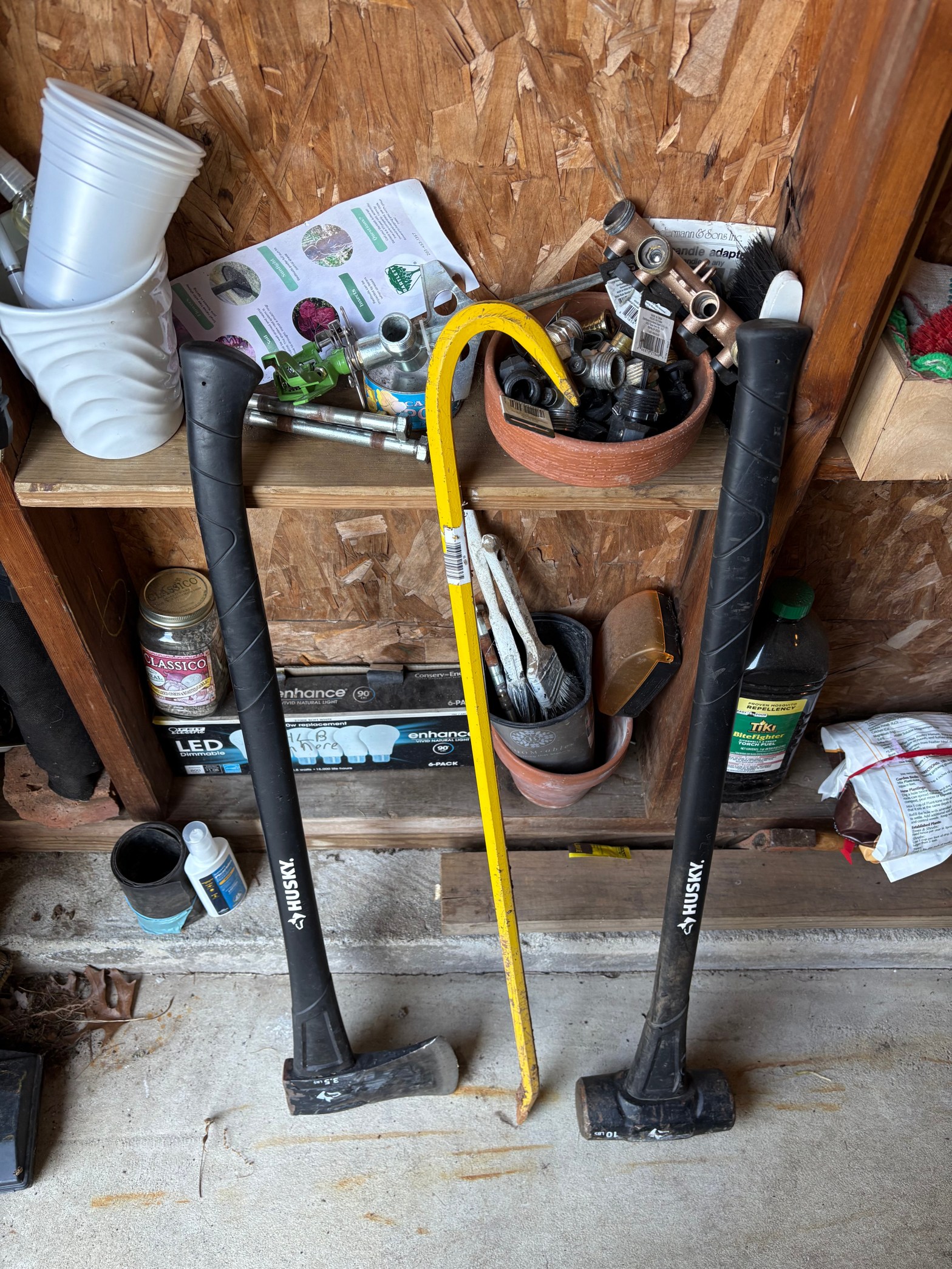
-An axe for splitting wood

-A crowbar

-sledgehammer and wedge

Tools! If you have a vehicle, basic tools such as an axe, a crowbar, and a sledgehammer / wedge will be extremely useful. Bonus points if you use them regularly for yardwork already, and have a sense of how to do so safely so when an emergency arises, they aren’t like strange foreign objects nobody has ever seen.

-hammer and box of nails

-bottle of ibuprofen

-portable gas generator. The Honda EU2200i is the consensus pick for powering basic necessities briefly for a month, and goes for about $1100.

-3 full five-gallon gas cans

-Seven gallons of water per adult, five gallons per child. That’s 14 for two people, 24 for a conventional family of four. Hard to pack in gallon containers; easier in 5 gallon containers or larger. Expect to begin refilling this stock ASAP. As mentioned earlier, potable water will be one of your biggest ongoing struggles.

-Soap

-Dishes and utensils

-sponges

-one towel per person

-A rifle or shotgun with a box of ammunition (in addition to the pistol)

Food, water, and fuel. Those are the basics. One can effectively make fuel to heat oneself and to melt water with an axe (by chopping firewood). One can procure water from one’s surroundings — easily or less easily depending on where you are, and where you plan to go. With enough food for the essentials, and knowledge of one’s surroundings, it may be possible to add forage to one’s diet.

You’ll have enough food and supplies to survive for a month, and depending on how far greater mobility with a vehicle. The more austere the environment, the harder it will be to survive, even with equipment. Ideally the place you choose will have supplies sufficient to provision you and your mode of transport — close to a fresh body of water (lake, river), and close to fuel in the form of gas or electricity (airport, highway rest stop, rural town or small city). Think through not only what you’ll need, but how to get more of what you need.

One should begin planning where to go and understanding the effort required to get there on the first day one leaves the site of the disaster.

At some point I will write a followup piece to this, covering how to respond to a disaster by remaining in place where and when feasible. But the effort of writing this has exhausted me.

Horseshoe Crabs in Branford

The horseshoe crab is one of nature’s oldest fauna, claiming a history that stretches back 250 million years to the early Triassic. For dinosaur fans, that means that a stegosaurus, famed for the gaudy kite-shaped plates on its back and spiked tail, might have seen horseshoe crabs while stomping along a Jurassic era beach. I don’t know if that fills you with wonder, but it amazes me.

This is why every year, if I happen to be in Branford during the full moon and high tide in May or June, I head down to a couple beaches to count horseshoe crabs. This is the time of year and the occasions on which they crawl up to the beaches to mate. The full moon makes it light enough to see the crabs, and the tide means there’s just a little band of beach on which to look. It’s not difficult.

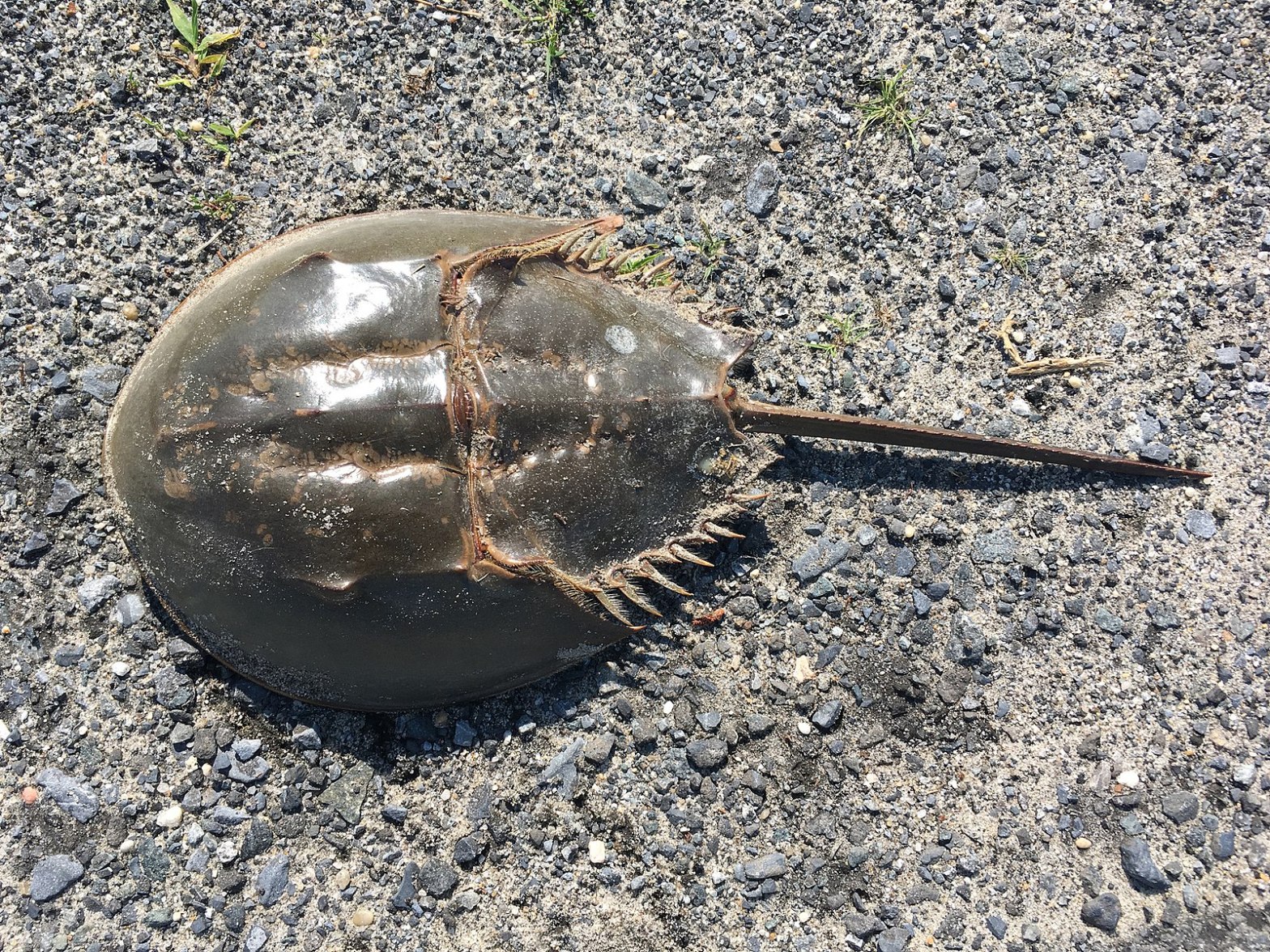
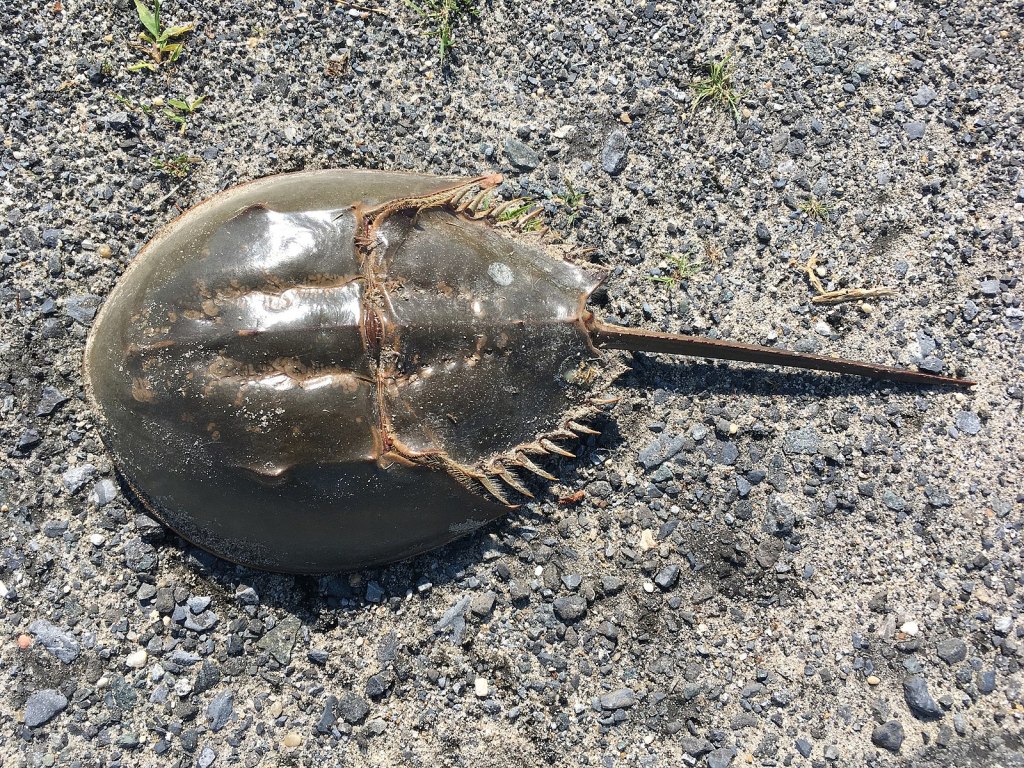
A horseshoe crab on what appears to be rough concrete
A horseshoe crab; photo via Wikipedia Commons

I’d missed 2024 — I’m not sure where I was, probably traveling for work — but the year before, action on the beaches was light — two pairs on each of the two beaches I surveyed. Before that in 2023, it was two pairs on one beach, and four on another.

When I was growing up and carrying out this practice in the 1980s and 90s, there were so many horseshoe crabs it was difficult to keep count. 

Mine is one anecdotal account, but you don’t need to rely on it to understand horseshoe crabs are in trouble. The acidification of the ocean, warming oceans, predation by other species that depend on the horseshoe crabs and (worst of all) harvesting by the biomedical industry — the horseshoe crab’s blue blood has strange and beneficial medicinal utility — all conspire to create a dangerous and potentially extinction-level challenge for this ancient species.

***

What does it mean, to lose the horseshoe crab locally? It doesn’t do much for people who spend little time at the beach — at least not as far as they can see. Unless you’re a bird or a fish it’s quaint at best, and alarming at worst; while its claws are too weak to deliver anything more inconvenient than a light pinch, the horseshoe crab is actually a distant relative of spiders, ticks, and scorpions, and attracts with its shape and its shell some of the instinctual revulsion we reserve for those loathesome creatures. Even crabs and lobsters can make for good eating. Maybe not if you’re pulling them out of Long Island Sound! But in general.

Losing the horseshoe crab in Branford may not affect the crab’s long-term prospects. It has survived several extinction events, and under different circumstances. It’s entirely possible that the departure of the horseshoe crab from Branford’s shores is a temporary situation, something that lasts hundreds of thousands of years — the briefest of flashes in the creature’s unfathomably long lifespan.

But losing the horseshoe crab — like losing the American chestnut, and the elm tree, and other large, old trees that used to be mainstays of the community — like losing monarch butterflies and wild bees — is part of something bigger, something that’s accumulating. Gathering momentum. The old, quiet way of life, where you could walk down to the beach and run into an animal from another epoch. We’re losing our community, is what’s happening. And what’s replacing it is far worse. Smartphones, AI, algorithm, and fear of the neighbors we no longer encounter on the road or when we do, are buried in a screen or listening to music on headphones.

It’s not just the horseshoe crab that we’re losing; we’re losing so much more. What will replace it, when the last crab surfaces some year soon, regards the empty beach, and returns to the sea? And what will we do, when at some point we run out of things to lose?

Branford’s 2026 Budget

Last week, my town (Branford, Connecticut) passed a budget for the upcoming year (2026, for readers keeping track from the distant and unknowable future). That budget will fund the town’s departments and activities. As Chair of the Public Services Committee, I had an opportunity to (along with the other members of my committee and members of the public) scrutinize the budgets of the Police Department, the Fire Department, and the Department of Public Works.

The town’s budget this year came to $141 million. Last year it was around $135 million. The jump was due to a number of factors, including inflation, the increased cost of goods which has been a problem since COVID, and expiring assistance from the federal government and state, also related to COVID.

The budget has gone up substantially, which would be concerning under any circumstances, but two other things have happened, related to the proliferation of remote work (and flexibility for folks moving from city to suburb): there was a recent revaluation of property that resulted in many homeowners seeing the assessed value of their home increase by 50-75% without their doing any work on them. There’s a housing shortage impacted by many factors that is driving the price of homes sky-high. Good for home sellers and nobody else.

What else has remote work affected? Along with subscription services and online shops, remote work has helped accelerate a longtime trend that’s battering commercial real estate. Fewer storefronts are profitable on shoreline Connecticut, where real estate is often the most lucrative use of land. Fewer businesses means business is shouldering less of the tax burden. And that means higher relative taxes for citizen homeowners.

If that wasn’t enough, events have conspired to raise the cost of electricity and health care. Whether this is the fault of state legislators, businesses, the governor, or national trends beyond anyone’s hands depends on who you’re asking.

And that was before the president decided to renegotiate the terms of America’s trade with the rest of the world, or to pause that renegotiation, or to start it again, or — reader, I don’t know when you’re encountering this, so let it only be said for posterity that there was much uncertainty as to the state of America’s economy in May of 2025.

Individual citizens in the town have said in meetings and in conversation with me that this is creating a “perfect storm” for them. Particularly for citizens living on a fixed income, such as older citizens or retirees. Things are getting more expensive, quickly. It’s not clear everyone will be able to keep making the payments they need to live dignified and honorable lives.

But the budget needed to be passed — the work of the town must continue — there are buildings under reconstruction (or Police Department HQ today, the high school roof next year) and vehicles to be bought or upgraded (particularly fire trucks, which have become vastly more expensive recently). $141 million must come from somewhere.

***

Before the budget was passed, it needed to be assembled. How does a town get to this point in the process?

The first step is departments assembling budgets based on needs and wants. Those departments, such as (under the Public Services’ Committee’s purview) the Fire Department, the Police Department, and the Department of Public Works — look at what they need to make payroll, and how to keep the equipment and properties they administer in good working order — and submit budgets to the administration. The administration oversees the function of the town. It approves the departmental budgets, packages them, and submits an overall budget to the Board of Finance for review and approval.

The Board of Finance reviews the budget as presented, and determines how to pay for it; largely through taxation. This is a fairly simple calculation in which the assessed value of Branford’s residential properties — the “Grand List” — is multiplied by the mill rate. The formula looks like this: a times b equals c, with a standing for the total taxable value of the Grand List, b standing for the mill rate, and c standing for the sum needed to pay for everything the town wants and needs.

Some taxes on commercial activity and revenue from departmental activity offsets the final bill to citizens, but these amount to subsidies; the bulk of the need for taxation has always and will always fall on the shoulders of taxpayers.

Once the Board of Finance has gone over the proposed town budget and determined the best way to pay for it, it recommends the mill rate (this step ultimately decides what a taxpayer will owe on their tax bill at the end of the year) and forwards the budget to the town’s Representative Town Meeting (RTM), which holds hearings and approves the budget or votes it down.

In practical terms the RTM is a little more than a formal rubber stamp; it can vote to pass the budget or not, but it cannot add more money to the budget. The RTM can subtract from the budget in certain ways; it can recommend or request that certain steps be taken. But it cannot (as Congress can do, for example) determine how and where to spend money by adding lines to the budget itself, it can only approve requests.

Once the budget has been passed the mill rate is set, and people know how much money they’ll owe at the end of the year.

***

There was some wrangling at the RTM this year; in fact, the vote for the budget was split down party lines, with the Democrats, who have the majority, voting to endorse the budget, and the Republicans voting against the budget. This was not because the Republicans had real problems with the budget, but because of one specific action that the Democrats (I am a Democrat so I was part of this) insisted on making: cutting the contingency fund from $1,000,000 to $500,000. The assumption behind that move was that in cutting contingency that the Board of Finance would bring forward another $500,000 from the undesignated fund to cover expenses.

Here, one needs to understand the difference between the contingency account, which is a bank account intended to be used for emergencies and unforeseen circumstances, and the undesignated fund (anecdotally referred to as a “rainy day fund”), a large pot of money left over from budgeting in previous years that is not assigned to any specific use. To put things in personal banking terms, contingency is like a checking account; the undesignated fund is like savings, money you put aside for bigger projects or in case you really need to confront an unexpected bill.

In the meeting it became clear that the Board of Finance and Republicans believed that Branford should leave its undesignated untouched, and save as much as possible in it. The state (Connecticut) recommends that towns keep about 9% of their budget back for the rainy day fund; to have the highest bond rating (which makes it easy to borrow money), it is more common to hold back 18% or even 20%. Some towns keep back more.

9% of Branford’s $141 million budget is about $12.7 million; 18% of that budget would be double that, or around $25 million. Branford’s undesignated fund as of this writing is nearly $47 million.

Cutting the contingency fund was the RTM’s only way of forcing the Board of Finance to pay for things with the undesignated fund — in this case, potentially offsetting taxes by $500,000, and reducing the mill rate by a negligible amount. The Republicans felt strongly that it was a mistake for the RTM to force the Board of Finance to spend money this way; the Democrats felt that it was important for the Board of Finance to reduce taxes as much as possible, particularly as we could afford to do so this year, and many of us had heard stories of hardship from Branford residents.

***

What a strange situation: the Democrats arguing for reducing taxes, and spending down what they saw as years of overtaxation — the Republicans arguing that the government (in the form of Branford’s administration and the Board of Finance) was being wise and prudent in collecting more taxes than the town needed to spend, saving for the purpose of allowing the town to meet any unforeseen catastrophe. One citizen, who publishes an online outlet that regularly defends the administration’s position, spoke out passionately in defense of the Board of Finance putting as much money as possible into the undesignated fund, and against the Democrats’ measure; he said that the town was saving money the way a responsible household should save money, and that spending that savings was “stupid.”

It was an extraordinary claim; if I understood it correctly, the idea was that the Board of Finance and the administration had, years ago, decided that the United States and Connecticut would be facing unnamed and unanticipated disasters including those prompted by climate change, politics, and trade, and began socking away money to create an undesignated fund big enough to tackle any problem. The citizen mentioned the likely absence of funds or assistance from FEMA after a disaster in Connecticut as an example of a potential place where the undesignated fund could be used.

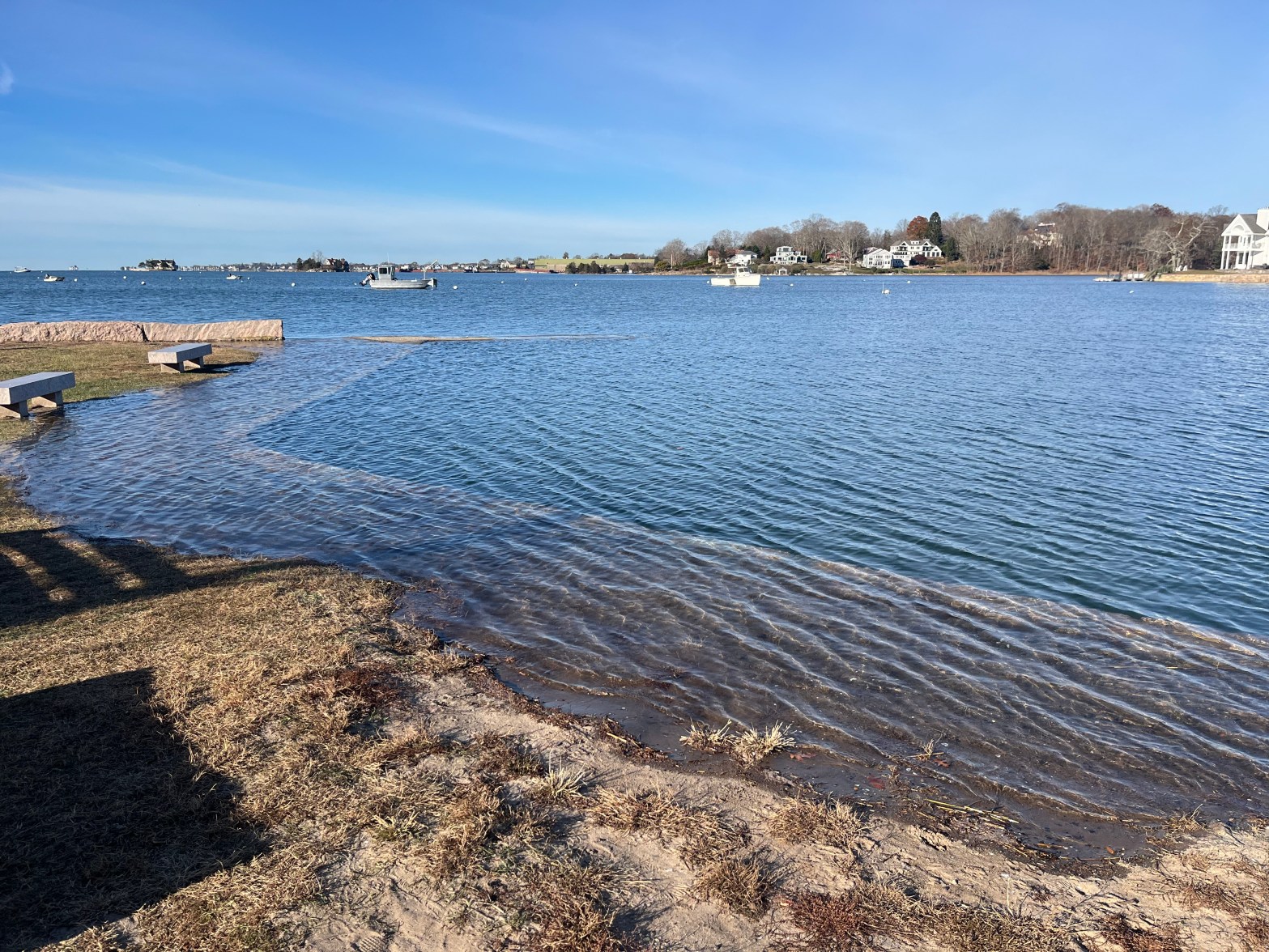
Photo of a very high tide in Short Beach
It’s getting more expensive to live in Branford at the same time that the water’s creeping closer to many shoreline homes’ front lawns

This is amazing! The Board of Finance and administration were able, years ago, to predict with a fair degree of accuracy the collapse of America’s central position in global trade networks, the federal government’s retreat from providing services, and Connecticut’s inability to step into that gap in the short term. They envisioned the undesignated fund not as a “rainy day” fund, but something far more urgent. Rain passes, the ground dries. If FEMA goes away, one doesn’t just put it back together; particularly if there’s little political will or ability to negotiate and compromise at the national level. All that stands between a Connecticut town and real hardship is the wisdom and foresight of that town’s planners. And in Branford, the administration began accumulating a war chest.

A rainy day fund is for some sporadic and small misfortune. A war chest is when you will need to spend deeply and as part of some great and all-encompassing social effort to keep one’s home safe for months or years. These things are of entirely different magnitudes.

I mean this sincerely; I don’t think that’s incorrect, I agree both with the citizen who spoke out, and if I’ve understood that citizen’s meaning correctly, I agree with the Board of Finance and administration’s logic in deciding to build the undesignated fund into something greater than it was originally envisioned.

However (one should never begin a sentence let alone a paragraph with the word however; these are, however, desperate times), while I agree with this assessment that Branford is at risk, and with the course of action the administration and Board of Finance elected to take, I do wish that they had communicated this decision more widely, and sooner. To begin with, citizens (myself included) would have gladly contributed to Branford’s efforts to prepare for the dire times that may nearly be upon us. If there was some initial resistance to the idea, it would have become extremely popular no later than COVID, when disaster first came home for most Americans.

And there has been a cost to Branford of keeping this assessment limited to a small circle. Not only was there no need for the Democrats to insist on cutting savings, but, again, as the administration and the Board of Finance feel that uncertainty and disaster are inevitable, we’ve lost valuable years when we could have been preparing the town in other ways.

Think about it. If you ask the Board of Finance to prepare for troubled times, what does the Board of Finance do? It saves money. What does the police department do? It hires more officers and expands infrastructure (it is doing both). The Fire Department hires more firefighters and EMTs and expands infrastructure (as it has) and attempts to more fully cover the town with emergency services. What about citizens? Well, they might buy a 24-hour capacity battery for their home for $5,000 instead of taking a long weekend at the Spring House Hotel on Block Island. A citizen might not buy a new car they were eyeing, instead electing to keep the old one and invest in repairs instead — or get a utility vehicle or a small pickup truck. They might attend Red Cross courses to achieve certification in Basic Life Support to help with health care crises, or buy a chicken coop and the ordinance-permitted four chickens for their back yard to cut down on spending for eggs.

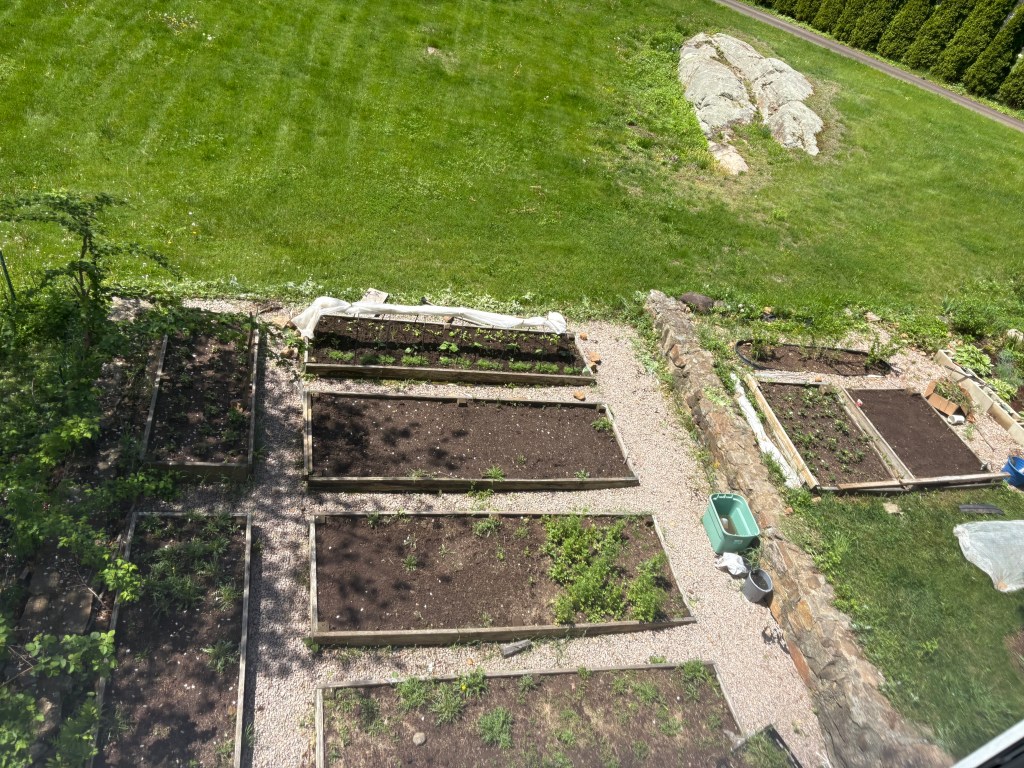
A vegetable garden seen from above

As I understand it the Board of Finance and Branford’s administration assess that for various reasons, Branford may not be able to depend on the state and federal government for help when it comes to certain things. I share that assessment (in fact I’d take it a step further, we shouldn’t depend on the state or federal government for many things we do). The Board of Finance and Branford’s administration are doing what they know to do to prepare for those emergencies: saving more than they would otherwise, investing now in services that can help cover gaps left by receding state and federal entities.

If the logic behind Branford’s huge undesignated fund is that we will need it for emergencies soon likely to confront us, that information should have been shared more widely. In saving our tax dollars (a good thing), we have missed years worth of time that could have been invested in leveraging volunteer energy adjacent to the police, emergency response, and in individual households (a bad thing). As things stand and knowing that the logic behind the undesignated fund is concern over the town, state, and country’s future, citizens must begin the process of supporting local initiatives now.

There’s a limit to what money can do, especially in the middle of a disaster. If you don’t believe me, read the articles about wealthy people in LA trying to flee the wildfires of last year, unable to hire helicopters willing to fly them out at any price. When the bad time comes, better to have the helicopter than enough money to buy 10 helicopters. The utility of cash drops off fast when the storm arrives.

Take it from someone who’s seen not one but two countries face war and invasion (a specific form of disaster). Afghanistan fell apart under the pressure brought by Taliban and under the weight of their own corrupt government; a deeply democratic and patriotic Ukraine bent but is still unbroken. When a disaster or disasters arrive in whatever form, if you’re not already prepared, it’s already too late. All the money in the world won’t make things better, then. You want to prepare today, before calamity arrives. What should Branford do to prepare besides continuing to grow the war chest that is the undesignated fund — the equivalent to stashing cash under our proverbial mattress? We should probably develop a plan with the fire department and police department to mobilize citizens for the various challenges they’ll need to be ready to overcome together, and which we can’t really afford to employ professionally on a permanent basis. This will give us the best chance of coming through these troubled times stronger than we were when we entered them.

This, friends, is one reason we have an RTM; this is why we have a citizen body that asks questions, and makes motions, and debates matters on the floor in public. Without this arguing over what to do with the budget and why, without the Democrats and Republicans disagreeing, we never would have known the reasoning behind Branford’s otherwise incomprehensible fixation on saving more money than anyone else says is necessary or prudent. Now that we know the logic — and can agree with it! It is prudent to save unusual amounts of money if we’re likely to face unusual problems! — we can embrace that logic across the town, and fully engage and organize the town’s citizenry to face those problems. The only question that remains is: how?

Changes to My Social Media Policy

Last year, even before a presidential election that was extremely unpleasant (both in its conduct and outcome), I had resolved to leave Twitter. Under Musk, the platform had become an unflushable toilet bowl filled with lies, insults, slander, propaganda. Mistruth after vomitous mistruth piled up in Twitter until that’s all one could see. After months of struggling with the reeking heap, I decided that for the sake of my own honor and integrity, I could no longer contribute to it. By mid-November, I’d stopped posting, and moved over to Bluesky.

This mirrored another slow move I’d been making on social media. In 2023, while in Ukraine, I deleted my Instagram account. At the same time I ratcheted back my posting on Facebook. I’d get much less traction on essays I posted, and posting them often led to the people who seemed to get the least out of my writing logging on to give me grief about it, or take exception to claims I made. I don’t have a problem with people disagreeing with me, so long as we can all agree on the facts. But these were people I knew explaining to me things I knew to be untrue — telling me obvious lies such as Russia had invaded Ukraine because of NATO, or that we were winning in Afghanistan until Joe Biden decided abruptly to withdraw U.S. forces.

To replace my posting on Facebook, I got more active on another network — Nextdoor. Commonly roasted on Twitter and other social media sites as a hotbed of bourgeois reactionary boomerism, on Nextdoor I found something I hadn’t really expected. Posting mostly about the garden or walking my dog — very commonplace and “local” ideas and ideals — my posts attracted interaction from a lot of neighbors, some of whom I knew, some of whom I didn’t.

Photo about some work I did cutting back an infestation of burning bush in a local Land Trust territory. It got a bunch of likes and one crazy person compared my work on the trees with killing swans!
Photo about some work I did cutting back an infestation of burning bush in a local Land Trust territory. It got a bunch of likes on Nextdoor and one crazy person compared my work on the trees with killing swans!

Now people come up to me at public events and tell me that they enjoy my posts on Nextdoor. It used to be a person might hear about something I was doing or see an essay on Twitter or LinkedIn or Facebook and tell me that they’d seen me on social media. Now it’s  a person coming up to me at a colleague’s retirement party in New Haven and saying: “I enjoy your Nextdoor posts!”

This was the promise of social media. That activity and networking online would enhance things offline. Shopping would be easier. Friendships, more meaningful. Our lives would become more transparent to others around us in ways that added to both. We’d be sharing joys and experiences, and bettering humanity. For a while it seemed like that’s what was happening. If it was ever the case — I don’t remember, it was so long ago — it is no longer, especially on the platforms I’d been slowly and then abruptly abandoning.

While it’s easy to blame politics or culture — Musk’s purchase of Twitter, which I’d used to share stories and essays with readers and network with journalists; Zuckerberg’s rightward turn with Facebook — but it’s also that any time one invests too much time and effort into “building a brand” or establishing some sort of identity in an institution over which one has no control, fundamentally, one will end up losing. Facebook and Twitter are giant companies, whose ultimate goal is not to facilitate community or connections — it’s to sell their users on something. Maybe that something is advertising, maybe it’s a political or ideological vision of the world. Ultimately it’s not up to you, the social media user. It’s up to the people running the platforms.

Having said that, you have agency. The answer to places such as Twitter and Facebook becoming less usable, less friendly, is to use other platforms. Either stop using Twitter and Facebook entirely (as I said, I deleted Instagram, have deleted TikTok and am barely active on Twitter beyond logging in once a day or so to make sure nobody’s hacked my account) or pull back — and use other social media platforms instead, or none. As a writer and sometime journalist, I use Bluesky now instead of Twitter, and haven’t noticed any significant dropoff in readership or conversation. I use Nextdoor now instead of Facebook and what I lose in international reach, I’ve more than made up for in terms of connecting with neighbors. My social media life overall, I would say, since moving away from Twitter and Facebook, has improved. That’s not nothing.

I still haven’t found a replacement for LinkedIn, and I’m not certain that there’s one out there. Because I am happy with my job, I’m not really in the market for a replacement. And once one gets past the flood of drek from LinkedInfluencers, it’s pretty good for finding job opportunities and sharing analysis. I can’t complain about the place.

Folks, things have gotten better for me! If social media has you down and you’re on Twitter and Facebook, change things up. Leave the old, be a part of reinventing the new. And expect that when Bluesky and Nextdoor change and go awry — everything does eventually — there will be a new place for community to gather. Flexibility and adaptation is the human way. In an era of climate change and war, nothing could be more natural.

See you online!

What Would it Take To Secure and Militarize the U.S. Border?

There are people who want the United States to have secure borders. Few of them understand what such a project would cost, and fewer still understand what goes into border security.

My home town is considering spending $20 million to renovate our police station. From flood control and mold remediation to a bigger locker room for the growing number of women on the force, to a fence for the parking lot and an indoor firing range and more, the town hopes that this hefty investment will mean the station doesn’t require further money years from now. $20 million for peace of mind for the police for a couple decades, and peace of mind for the police is peace of mind for citizens.

A few years ago the number that was estimated for these renovations was $5 million to $7 million — as recently as October of 2023, the expectation was that the bill would come to $10 million to $13 million. Labor’s getting more expensive, and so is the cost of materials.

All this to effectively headquarter and base 56 police officers for our town of 28,000, size: 28 square miles.

Why am I talking about my home town’s police station in an essay about border security? To add some context to a discussion that rarely penetrates further than an idea. Ideas are always different from implementation — one reason communism failed so spectacularly in the 20th century. When the original architects of the police station imagined how it ought to look, for example, they didn’t take into consideration how water would flow downhill and into the station’s basement. They didn’t imagine the growth of women on the force, or how policing itself would change, making it difficult to modify the existing station without spending lots of money.

Here’s what people who are arguing for border security say, and why what they say is far less practical than they’d have you believe.

#1: Border security is simple, all countries do it

Border security is complex and costly, which is why countries over time try to reduce or eliminate as much of it as possible. It costs a lot of money to train personnel, field them, and administer them properly. It costs money to pour concrete and fabricate and install fencing and surveillance — money that doesn’t come back, sunk costs you’ll never retrieve.

Up to a certain point, border security is necessary. But one is always grasping to reduce it — to do the minimum necessary. This is why states in the United States of America tend to reduce border security to collecting tolls for the use of their roads, and why one of the first things the European Union did was to take down the customs checkpoints that used to crisscross Europe when I was a young adult.

You don’t spend money surrounding your country with fences and walls unless absolutely necessary, because otherwise, it’s wasted money — twice over, the money you spend, and the money you lose when people do business elsewhere because it’s such a hassle and pain to get into or leave your country.

#2 For thousands of years, countries have done border security

Comparisons that reach back thousands of years are tricky, and almost impossible when it comes to conceptions of citizenship and migration. Prior to the 19th century countries didn’t worry much about people coming into their country or leaving it — linguistic barriers, cultural barriers, and a far higher bar for leaving or entering societies that largely depended on kin groups dissuaded widespread migration. When we’re considering the modern problem of border security and migration, we must acknowledge that we’re really only looking at countries and nations over the past 200-250 years.

Nations, empires, and kingdoms of the past were concerned primarily about their borders in military terms, rather than as physically defined legal spaces affecting where citizens of various countries could or could not go. The Great Wall of China was built and garrisoned to protect China from raiders to the north (it famously failed to accomplish this modest task). Hadrian’s Wall and the Antonine Wall were Roman attempts to do the same, against the native tribes of northern Britain and Scotland. These were not fortifications designed to keep merchants or travelers out — countries were not very interested in who was traversing their land, unless that who was working for a hostile power.

Not only were kingdoms and empires generally unworried about foreigners coming into or going out from their domains provided that those foreigners weren’t bent on conquest, they often recruited skilled experts or even unskilled laborers to build or settle — this is how the map of Europe circa 1900 came to be so speckled with German settlements. There is to this day a population of Germans residing in Romania (much smaller than they were in 1945), some of the people who were invited to farm and protect what were then Hungarian lands in the Carpathian mountains, centuries ago. Modern day fans of horror know this region — Transylvania — for the mythical vampires that inhabited these German-built castles. It’s also how Yale and the University of Michigan, Ann Arbor came to look the way they did — expert Italian stonemasons brought over to build in a style that American workers could not, many of whom subsequently settled in New England.

Before the 19th century, few kingdoms or countries worried much about who was living or working within their territorial borders. They worried primarily about borders in military terms.

Some ancient or pre-modern states did actually worry more about border security more than usual and in terms more or less comprehensible to modern thinkers. Those that would presumably be held up as examples by the people in the U.S. talking and thinking about border security all collapsed shortly after focusing on committing to controlling or policing who lived inside their borders. The act of fully committing to border security seems to correlate with kingdom or empire collapse. While I can’t claim a causal relationship, it’s worth noting that when a nation or people or kingdom focuses their treasure and energy on building walls and actively patrolling their borders, that seems (for whatever reason) not to lead to more productive outcomes, culturally, socially, and economically, let alone militarily.

TLDR; for thousands of years, states have done border security as little as possible. When they do sometimes focus maniacally on securing and militarizing their borders, they often end up collapsing (often violently) and disappearing soon thereafter.

#3 Border security won’t break the bank

I’ve done border security — on the border between Afghanistan and Pakistan — so know something of what goes into the process. For the type of tight border security required by people serious about border security — for a *militarized* border, here are some of the requirements.

  • An area covered by lines of barbed wire, fencing, lights, surveillance cameras, and, ultimately, a physical wall. That area should have a depth of at least 100m, and ideally more like 300-500m. Think about that band running along the U.S. border with Mexico and Canada.
  • Sufficient personnel to patrol that border; every portion of the wall ought to be physically patrolled (to supplement cameras) by team-size elements, with larger groups standing by as QRF. An obstacle isn’t an obstacle if it’s not observed, and even the most sophisticated fixed or drone-mounted cameras are only *deterrents* — for security one needs armed border guards. How many guards would be needed? An army’s worth. In the hundreds of thousands. To say nothing of those required to patrol the waters that also make up a large portion of American borders. Don’t believe me? We had 300 soldiers in Afghanistan along a mountainous 40-mile-long border and might as well not have been there in terms of how many people we were able to disrupt. Of course, we weren’t trained for border security — we were trained for airfield seizures and offensive operations, and, to a certain extent, counterinsurgency. Border guards require their own training and administrative apparatus.
  • A band of 20-25 miles free from habitation that is essentially defensible / prepared terrain, in which to conduct military exercises. A “militarized” border is a border the military is prepared to defend, and that preparation means moving all civilians out, and creating space in which units can conduct defensive and offensive operations.
  • A much beefier law enforcement set within 25-50 miles of the border, both the land borders with Mexico and Canada, and every inch of coastland. This zone will require special identification, and people living there should be subjected to frequent and random searches, both of their persons and their homes — this area of border, while not militarized, will be where people covertly flying, tunneling, beaching, or being smuggled into the country will arrive, and it is there that anti-immigrant policing should focus much (though not all) of their efforts. And yes, as soon as it becomes very difficult to bring people into the country, there will be a huge financial incentive to smuggle people into the country, so the country will have to take that threat seriously.
  • 1-4 (especially 4) will require changes to important laws, including but not limited to rights guaranteed in the Constitution (most obviously the 3rd, 4th, and 14th amendments).

Considering these points, which are preconditions for true border security — not false or incomplete border security (incomplete border security being a dangerous illusion, or a lie), what would be the costs? At least tens of billions of dollars per year to maintain, and hundreds of billions or more to build. To become completely, perfectly secure, we’d need to invest a ton of resources, labor, and ingenuity in that one specific task, securing Alaska, the Continental U.S., and Hawaii.

One likely objection, easily dismissed

is that the U.S. only needs to secure / militarize its southern border with Mexico. Of course, once that happens people will simply go in through Canada, which lacks robust border security with the U.S. and also around its own territory. My friends and I used to cross over into Canada illegally while boating on the St. Lawrence River, not through any malice or deliberate attempt at mischief but because we were on jet skis and not paying close attention to where we were. A border that is not patrolled will quickly become a route by which people make their way into the U.S., no matter how unlikely it may seem to people at present. There were tens of thousands of border crossings on foot by Afghans and Pakistanis near where our post was, and that was at 8,000 feet above sea level, in the mountains, without roads. What seems like an insurmountable impediment to a person living in suburban comfort is a mild inconvenience to a dedicated migrant.

ocean crashing onto a beach
Pleasant beachfront property along the Atlantic and Pacific oceans will become a space that is subject to frequent patrols by uniformed border guards and searches and surveillance by law enforcement.

It is possible to secure the U.S. border and militarize it — though the cost would be great, perhaps even greater than the cost of colonizing the moon or Mars. And there is a further cost to doing business that way; when one becomes focused on security, and walls, one atrophies as a culture — one begins looking inward, rather than externally, for answers and opportunities. While this might be satisfying on a spiritual level, for a country such as the United States — a nation built on connections and commerce, dedicated to profit through trade, and the free, meritorious exchange of capital — such an evolution would be a serious blow, perhaps even a fatal one.

Border security is a contentious political issue, not only in the U.S., but also globally. Countries have become increasingly concerned about controlling their borders, and in ways that are very new, relative to the age of civilization. When one considers the costs (money, creativity, flexibility) against the benefits (the halt of almost all illegal immigration), it’s difficult for a reasonable person to conclude that a “militarized border” and border security the way advocates mean is truly a worthwhile endeavor. Unfortunately, I doubt very much that this will stop people from complaining about it as an issue. After all, it’s easier to complain about a thing than to fix it.